
If you collected sports cards as a kid, you might be wondering where all these six- and seven-figure cards came from, especially the freshly printed ones. Scarce cards (such as the 50ish known examples of the T206 Honus Wagner from 1909) and hotly desired ones (like the rookie cards of beloved stars) have long drawn big price tags. But never before have supply and demand for high-end cards been so perfectly calibrated.
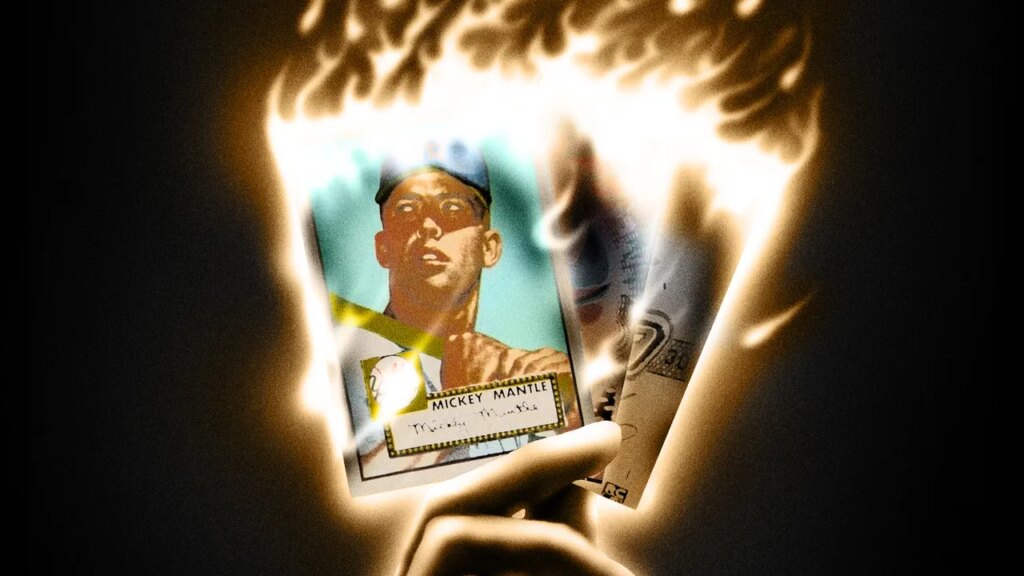
Though versions of sports cards have existed since the 1860s, their modern history begins with Topps in the 1950s. For decades, Topps was the undisputed king of cards, effectively controlling the stream of collectibles to collectors. While some cards from this era eventually became extraordinarily valuable, like the 1952 Topps Mickey Mantle, they were generally worth very little at the time. In 1980, an antitrust suit opened the door to competitors like Fleer, Upper Deck, Donruss, and Score, flooding the market with cards. Print run details are kept secret, but according to one estimate in The Athletic, Donruss printed somewhere between 3.7 and 10 billion cards in 1991 alone—and that’s just one company. Collectors refer to the peak of this production glut, the late ’80s and early ’90s, as the Junk Wax Era.
Out of this dark age emerged perhaps the biggest innovation in sports card history: the insert. In the early-90s, manufacturers began putting a limited, publicized number of cards—eventually with shimmering holographic material—in with the rest of the pack. Within any print run, they could inject a finite supply of rare, flashy cards to work collectors into a froth.
Card manufacturers continued developing increasingly baroque forms of special edition cards. In 1997, Upper Deck introduced the relic card, which includes a piece of game-worn jersey, bat, glove, or other equipment in the card itself. That same year, Fleer created the first one-of-one cards. Today, Rookie Debut Patch Autos—one-of-one rookie cards that contain a piece of game-worn jersey from a player’s first game and their autograph—represent the stratospheric top of contrivances in rarity and, by extension, price.
Still, for various reasons—video games? The Great Recession?—demand for cards declined in the new millennium, the industry contracted, and The Hobby sputtered along. Then, a novel coronavirus appeared in Wuhan, China.
Stuck inside with nothing to do, people picked up new hobbies or, as was the case for many collectors I spoke to, revisited old ones. Now, they could buy cards with their adult salaries instead of an allowance. Between stimulus checks and canceled vacations, many found they had some extra cash. eBay reported a 142% increase in trading cards sales in 2020, citing “an industry-wide surge in collecting and flipping” due in part to fans “turning to cards while there was a lack of sports on TV.” That year, for the first time since the industry’s early-90s peak, total sales of new sports cards reached an estimated $1 billion.
Then, in January 2022, Topps was acquired by Fanatics, the $31 billion conglomerate that rose to prominence as a sports apparel retailer. Under Fanatics, Topps cemented exclusive trading card licenses with the MLB, NBA, NFL, and their respective players’ unions, eventually becoming the sole official card manufacturer for the three leagues. (Upper Deck still has the license for the NHL and its union.) Now, amid new highs in demand, one company is able to carefully manage the majority of the official sports card supply, avoid the overproduction of the Junk Wax Era, and double down on developing incredibly rare chase cards, all culminating in today’s mind-bending, headline-grabbing valuations.