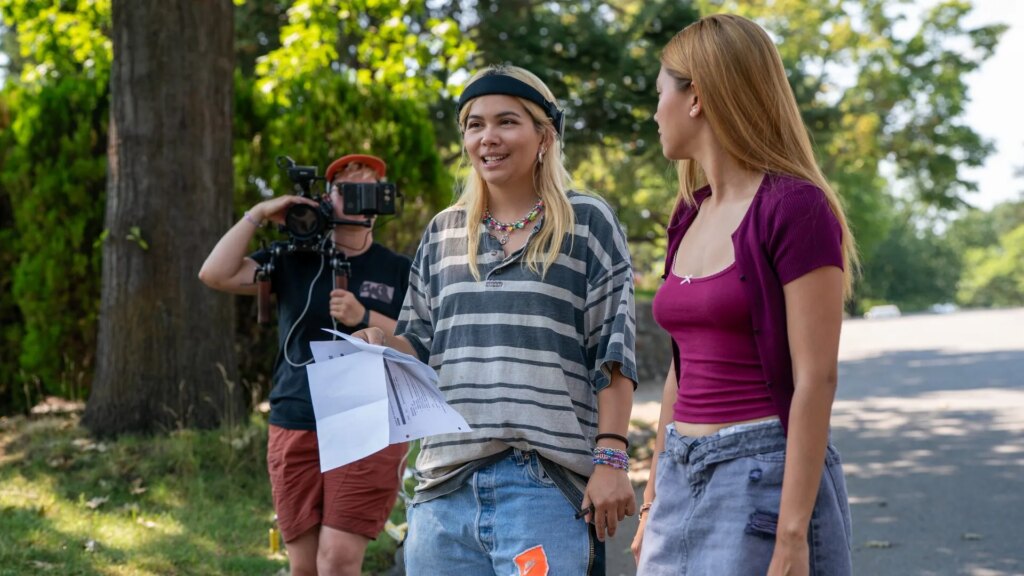

Hayley Kiyoko might be best known as a singer, but she’s a lot more than that. Actor, author, music video director, and now feature filmmaker, Kiyoko is a creative in every sense of the word.
As a queer person of colour, Kiyoko is an LGBTQ+ advocate who explores the sapphic experience through her art, perhaps most notably with Girls Like Girls. The coming-of-age story has been told through lyrics, a novel, and now a feature film.
FILMHOUNDS spoke with Kiyoko before the release of Girls Like Girls about expanding the story on the big screen, representation, and what’s next for the talented artist. Below is a snippet of the full interview, which you can read in the latest issue of FILMHOUNDS Magazine.
Was there ever a world where you were thinking about expanding the music video after you saw so much support, but that it was going to be different? Were there earlier drafts that were different, or was it always going to be a continuation of the music video?
I mean, the film is very different. The time is different. I think the music video at the time we didn’t set in 2006; it just was when it was. The characters are different, the situation is different, but visually, obviously, the setup of the two girls falling in love and ending in hope have similar through lines that I definitely wanted to keep and protect. Following Coley and Sonia’s journey and expanding it into a feature film has been so rewarding because we were able to dive deeper than just the four-minute music video that barely scratched the surface of representation.
And speaking of representation, you’ve obviously spoken about, at length, how this film is very personal to you. But what was it like having to balance creating a film that was still containing reflections of your life and being so personal to you, whilst carrying the expectation that it would reflect the experiences of the audience and resonate with them?
Thanks for asking that. Anytime I get in my head, I have to remember that the reason why Girls Like Girls resonated the way it did was because it felt authentic and truthful to me. So anytime I had gotten lost on the path of like, well, what are other people going to resonate with? I had to go back to: what do I resonate with? What do I wish I could see in a film? What are the beats and the feelings. A lot of my experience growing up being queer was very silent. I wasn’t able to verbally express it to a lot of people.
So how do I visually show that in a feature film? I had to trust that instinct that other people would feel that way as well. And that’s the thread through my music, my music videos, my books, and this feature film, and my directorial debut is all of these iterations I have felt connected to.
You’re part of an increasingly large club of musicians that turn from one medium to another; musicians turn into filmmakers or actors or authors. And for you, you’re pretty much ticking every single box, which is remarkable. When you approach making a music video or writing a book passage or directing a scene, is there any crossover?
I think they’re all connected. They’re all very different processes, but they all need specific tools. And I do think that all the tools—the toolbox that I have built along the way—I was able to fully open and use every single tool while directing; whether it was collaboration, musicality, rhythm, the dialogue, the beats, writing the album for the film. Being able to storytell and world-build and collaborate with the production designer, my amazing cinematographer. All of these elements along the way, I’ve collected a tool for the toolbox. And that’s why I do really feel like I’ve arrived where I want to be, which is filmmaking and directing. My whole journey has led me to this point.
Read the full interview in FILMHOUNDS Magazine Issue #30.
Girls Like Girls is in cinemas now.