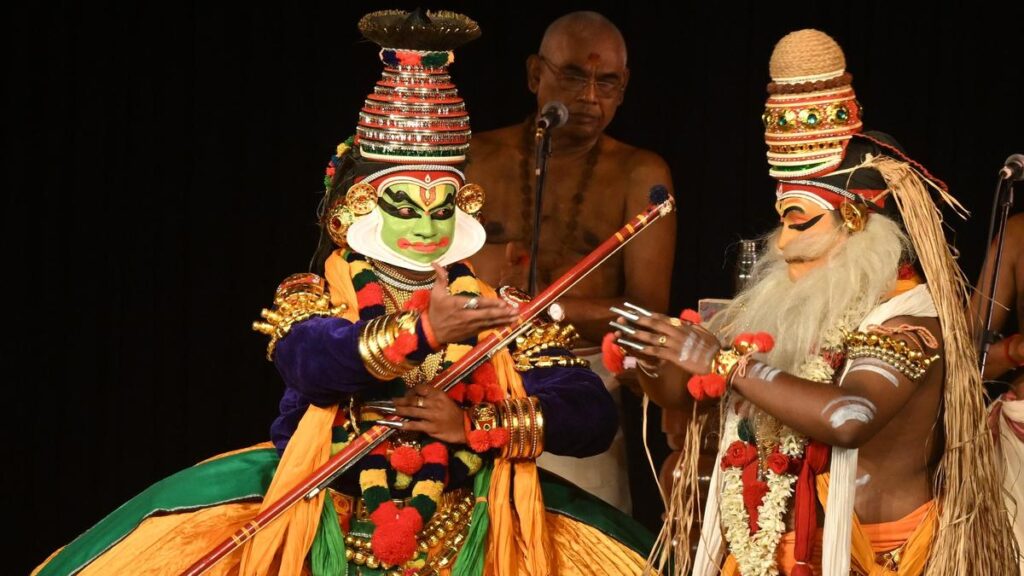

This year, Kalakshetra’s Kathakali Festival, titled ‘Kadha Rasa Sangama’, brought together three productions that explored the form’s capacity to engage with stories both familiar and unexpected.
The three-day festival opened with two new works: on the first day, Sadanam Academy presented ‘Mandodari’, which sought to foreground Mandodari as an independent and consequential character, whose role in the Valmiki Ramayana, particularly during and after the war between Rama and Ravana, is relatively limited. The play was not a straightforward dramatisation of a traditional Ramayana episode, but Sadanam K. Harikumar’s own Kathakali attakatha, built primarily from Thunchath Ezhuthachan’s Adhyatma Ramayanam, with considerable dramatic expansion of what the traditional texts leave unsaid. The central conflict thus became less Rama versus Ravana than Ravana’s struggle with his own obsession with power, with Mandodari representing the emotional and moral world he repeatedly ignored.

The production sought to jhighoreground Mandodari as an independent and consequential character.
| Photo Credit:
R. Ravindran
What stood out was the intensity of Mandodari’s grief and the emotional weight she carried through the story. Ravana was portrayed as strong, ambitious and uncompromising, remaining indifferent even to Mandodari’s humiliation and suffering at the hands of the vanaras. Yet, her reminders of his duties as a husband momentarily brought his love for her to the fore. Her interventions gave her a more consequential role in the narrative, even as she remained devoted to Ravana until his death and beyond.
The Sadanam performers brought these characterisations across effectively: Mandodari’s anguish was particularly compelling, Ravana’s formidable nature came through strongly, while Rama was swift and energetic in the war sequences. Neela and Angada added humour and warmth with their lively camaraderie. Formally, the production remained rooted in Kathakali’s established conventions of music, percussion and sequencing. Its distinctive feature lay in its narrative focus — a familiar Ramayana story reframed around Mandodari.
‘The Old Man and the Sea’, directed by Neeraj G.M. and presented by Kerala Kalamandalam, on the second day, was a compact 90-minute production. It was an unusual Kathakali adaptation of Ernest Hemingway’s celebrated novella. Santiago, an elderly Cuban fisherman, ventures into the sea after 84 days without a catch and battles a giant marlin. Though he succeeds in killing the fish, sharks devour most of his catch on the journey home. Beyond the physical struggle, Hemingway’s story explores endurance, dignity and man’s relationship with Nature. Neeraj’s production explored whether Kathakali’s highly codified language could portray an ordinary fisherman’s physical and existential struggle, far removed from its traditional world of mythological and royal heroes.

Kerala Kalamandalam’s ‘Old Man and the Sea’, an adaptation of Ernest Hemingway’s celebrated novella
| Photo Credit:
M. Srinath
The decision to dress Santiago as a fisherman rather than in conventional Kathakali costume lent greater realism to his character. Manolin, his young apprentice, provided a strong emotional counterpoint, while the personification of the sea added an imaginative dimension. The struggle to capture the marlin and the subsequent attack by the sharks were among the production’s most powerful sequences, using Kathakali’s movement vocabulary and forceful percussion to convey their physical intensity.
The unusual three-part stage, with a central platform flanked by two side spaces, allowed the performers to explore space differently, but its effectiveness depended heavily on seating; viewers seated away from the centre could not always get a complete view.
The festival came to a close with Margi Theatre’s ‘Rukmangada Charitham’. It offered the pleasure of seeing Kathakali in its full expressive richness. The production allowed the music, percussion, abhinaya and elaborate vocabulary of the performers to breathe. The musical quality of the padams was one of its principal strengths. Rich in melody and emotional variety, they provided the performers with an expansive canvas, particularly in the unfolding relationship between Rukmangada and Mohini. The sringara of their encounter received considerable attention, with their opening meeting developed through extended passages of abhinaya.

From ‘Rukmangatha Charitham’ by Margi Theatre
| Photo Credit:
B. Velankanni Raj
This is, perhaps, one of Kathakali’s greatest pleasures: a few words in a padam can become the starting point for an entire world of expression. A phrase describing Mohini’s face or her elephant-like gait, for instance, can be interpreted and elaborated. What might occupy only a moment in the text can become several minutes of richly nuanced theatrical exploration. The chemistry between the performers, playing Rukmangada and Mohini and their responsiveness to the singers and percussionists, made these passages particularly engaging. Beneath its sensuous opening, Rukmangada Charitham gradually moves towards questions of devotion, duty, love and sacrifice. The progression from sringara to the profound emotional turmoil of the final episodes gives the work considerable dramatic range.
The absence of English translations for the songs was a drawback. Kalakshetra usually provides translations during its Kathakali Festival, but this year, they were available only on the opening day. Such translations are particularly valuable for audiences unfamiliar with Malayalam. The festival has also done away with the useful practice of distributing handouts listing the cast and musicians, along with a brief synopsis of the performance. This too deserves to be reinstated.
Published – September 22, 2026 11:31 am IST