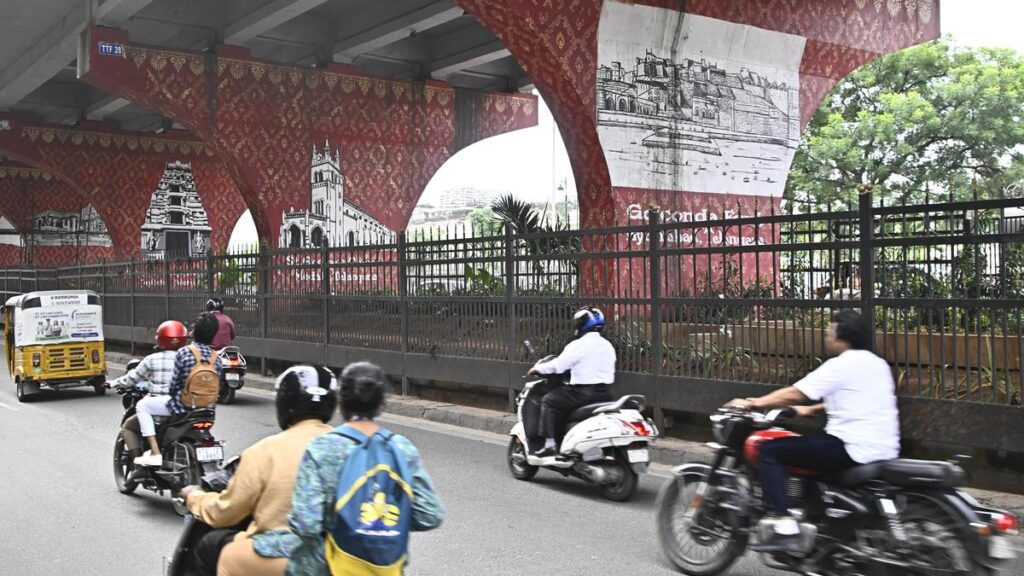

Hyderabad’s heart for art is growing bigger, evolving beyond traditional galleries to embrace diverse stories, forms of expression and new audiences. Installations, experimental media including performance and video art, unconventional exhibition spaces, public art, café workshops and a growing wall-art culture reflect its vibrant scene today.
But 50 years ago, Hyderabad was hardly buzzing with art. “There was no art scene and hardly any practising artists,” says 86-year-old artist Laxma Goud, tracing the city’s artistic evolution.
Collaborative studio

Renowned artist Laxma Goud
| Photo Credit:
CV SUBRAHMANYAM
Pakhal Tirumal Reddy, aka PT Reddy, is regarded as one of the city’s pioneering artists, but back then he was not widely known. “Only Narayanguda, the area where he lived and worked, knew about him,” rues Laxma, who, along with the late Surya Prakash and Devraj Dakoji, rented a garage in Himayatnagar to launch a first-of-its-kind collaborative studio.
The trio began with batik art using wax as a preoccupation, at the suggestion of the late art historian and collector Jagdish Mittal. They discontinued it after MF Husain, critical of their efforts, urged them to be original and aspire to be artists rather than craftsmen. “His words were sharp but gave us direction. It felt like a new dawn and brought a sense of vibrancy.”

Anjani Reddy paints on a canvas at an art camp
| Photo Credit:
K V S GIRI
Art in Hyderabad was creative, steeped in tradition and primarily figurative. Artists such as Laxma Goud and Thota Vaikuntam, whose work was heavily influenced by the region’s culture, ethos and people, were at the forefront. Surya Prakash was a pioneer in introducing abstract art to the city, but it took time to find its audience.
“The interest in contemporary art was greater in Mumbai and Delhi since the colonial times because of the prevailing social and cultural conditions, but we were steeped in tradition,” says artist and Iconart gallery founder Avani Rao Gandra. The idea of art, she says, was connected to the Lepakshi painting tradition, known for its rich, narrative style of mural art that helped with storytelling, community building and cultural preservation.

Kakatiya Kala Thoranam in Warangal – mural on Telangana Talli flyover near Secretariat highlighting regional heritage
| Photo Credit:
SIDDHANT THAKUR
“Many states do not have the beautiful traditions like Kalamkari, Nakash that we had in undivided Andhra Pradesh, which continue to enrich the two Telugu states now,” adds Avani.
Institutions such as Lalit Kala Akademi and Hyderabad Art Society nurtured artists through their initiatives. “PT Reddy garu, Vidya Bhushan garu and Jagdish Mittal garu were a triangle that elevated the art world, but the driving force was LN Gupta, an administrator associated with the Industrial Exhibition Society who was known for his love for art and innate sense of aesthetics.”
Renowned artists
DLN Reddy, (late) Vidya Bhushan, Syed Bin Mohammed, Kondapalli Seshagiri Rao, Gowri Shankar, Fatima Ahmed, Freny Behemen Shaw and Kavita Deuskar
Artists today can showcase their work in galleries and alternative exhibition spaces, but earlier, options were limited to hiring Kala Bhavan on the Ravindra Bharathi premises or exhibiting at the German centre, Max Mueller Bhavan. “But only outstation artists could hold solo exhibitions at the German centre,” recollects septuagenarian artist Anjani Reddy, who held her first solo exhibition at Kala Bhavan in 1991.
Challenges for artists

Avani Rao Gandra
| Photo Credit:
Special Arrangement
With hardly any art buyers, it was tough for artists to sustain themselves through their practice. “Art was pursued only by the passionate, as artists knew there was no means of livelihood. There were hardly any private buyers in Hyderabad because art was not a thing to be bought in those days.”
Surya Art Gallery, launched by artist Surya Prakash in the early 1990s, provided a platform, and gallery spaces gradually grew. Anjani, among the first in the city to hire a studio, in 1987 for ₹500, says the art landscape has since undergone a remarkable transformation. Avani agrees, attributing the shift to a younger generation exposed to museums and galleries while travelling abroad. “The surge in Hyderabad’s global outlook is palpable and reflects in its vibrant social life and openness to new ideas and experiences. This is the beginning.”

Hyderabad, Telangana, 31/08/2026: (For Metroplus) Art on Telangana Thalli Flyover near Secretariat in Hyderabad on Monday, August 31, 2026. Photo: SIDDHANT THAKUR/The Hindu.
| Photo Credit:
SIDDHANT THAKUR
As Hyderabad finds its place in a globalised art world, work reflecting regional identity is also gaining appreciation. “People have a renewed interest in the aesthetics of local narratives and have understood the brightness of colours, the distortion, the darkness of the face and realised they all have their own charm,” says Avani.
City as canvas
Beautification projects have transformed its public spaces and flyovers into open-air galleries but face maintenance issues without care.
Public art played a vital role in changing the city’s visual identity. When a quiet neighbourhood MS Maqtha turned into a canvas for the St+art India project a few years ago, an open-air art district brought contemporary art into an everyday setting.
Artists such as Swathi and Vijay work with graffiti and murals using public art as a form of social commentary.
Yet, as artistic activity flourishes, galleries continue to see low footfalls. “There’s too much exposure and instant gratification on social media, so the curiosity to go to galleries and museums is low,” she says. Still, she remains hopeful that in an increasingly virtual world, the craving for human connection will draw people back to galleries.
As Hyderabad’s art landscape continues to evolve and thrive, the fundamental issue is whether the city’s art ecosystem has expanded beyond galleries—into cafés, public spaces, neighbourhoods, installations and other unconventional venues—and whether this has helped art reach people who wouldn’t necessarily visit a gallery. According to Avani, these interventions do bring art into everyday life as casual encounters and enhance the spaces around but this does not create deeper engagement. “Galleries offer curatorial context, focused attention and a contemplative quality in its white-cube spaces. Within these spaces, the artist’s intention, process, material and medium can resonate with far greater intensity. Hyderabad needs to cultivate sustained interest in critical art appreciation and a deeper understanding of serious artistic practice.”
Published – September 04, 2026 08:53 am IST