
“I find love stories too boring,” declares Tigmanshu Dhulia during a freewheeling conversation about his upcoming film, Ghamasaan. The filmmaker’s voice carries a frustration similar to his much-quoted dismissal of cinema as the infamous Ramadhir Singh from Anurag Kashyap’s Gangs of Wasseypur. And like Ramadhir, Tigmanshu is excited by the world of crime and politics, something he has explored right from his first film, Haasil. With Ghamasaan, he returns to the world of dacoits, which he approached earlier with an earthy realism in Paan Singh Tomar. When asked what continues to attract him to this landscape, Tigmanshu is quick to chime in.
“Mera Mangal bohot strong hai (I have a strong Mars in my horoscope),” he says, smiling, and explains that he is approached only to make films about dacoits and cops. “I have been a huge admirer of these films since I was a kid. If I was not a filmmaker, I would have been in the army or police.”
There is more to his reasoning than that. Tigmanshu feels that there’s a lot to explore in characters living in rural hinterlands. “I don’t find urban characters as interesting, as people are not facing such conflicts in cities. There is no caste problem in Mumbai. Your surname doesn’t matter here as much, but that’s a reality in villages. So, when so much is happening in the world, why should I watch your love stories? What’s there in it? That’s why I don’t like them,” he says.
Tigmanshu is picky about other genres too. “I don’t watch every Hindi movie,” he says. He has not seen some of Arshad Warsi’s popular comedy films like the Golmaal series or Hungama. That’s what made him look at Arshad differently when he decided to cast the actor as a dreaded dacoit in Ghamasaan. “I had seen him in Sehar and, of course, in Munna Bhai MBBS. So, I never looked at him as a comedian. I knew he is a very accomplished actor,” says Tigmanshu.

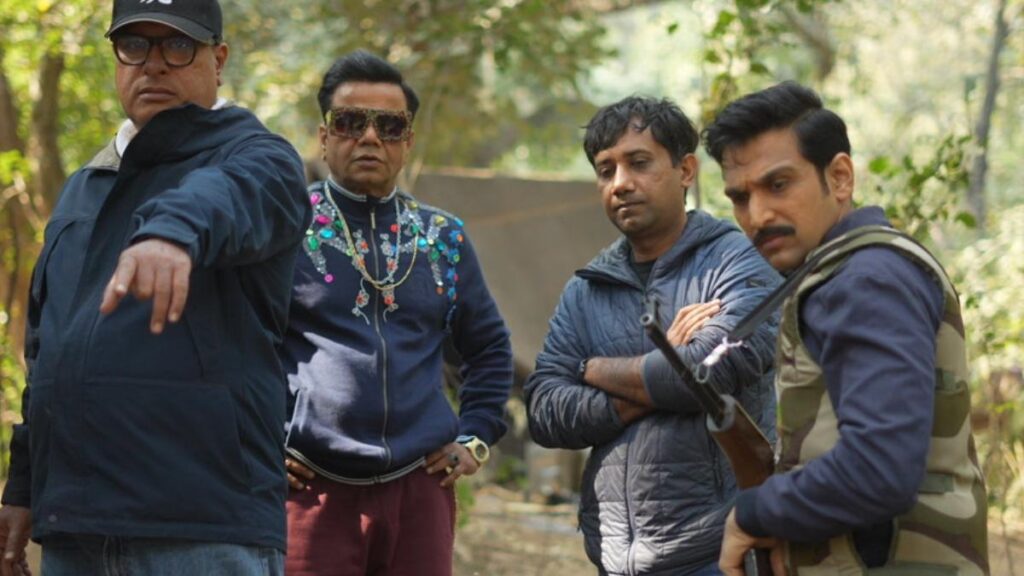
Tigmanshu Dhulia with members of the crew during the filming of ‘Ghamasaan’
| Photo Credit:
Zee5
Casting Pratik Gandhi was simpler, as the director had earlier worked with him on the mystery-thriller series, The Great Indian Murder. “I know his background in theatre, and I wanted someone who could improvise. I had a lot of faith in him and he suited the part pretty well too,” says Tigmanshu.
Pratik feels that the faith works wonderfully. “If a director is trusting your process, you can go beyond the pressure of performance and explore. That’s where the magic lies,” says Pratik, adding that he had understood the working style of Tigmanshu while working on The Great Indian Murder. “He is an actor himself, but he never acts and shows you. He talks you through an emotion that he wants you to play in a scene,” Pratik says.

The Scam 1992 and Madgaon Express actor maintains stunning restraint as an IPS officer in Ghamasaan, who is tasked with chasing the hyper-violent Maharaj (Arshad Warsi). Pratik instils an ordinariness in his performance, a quality that he uses to humanise all his characters. “I personally like minimalism a lot, with which you can communicate something that is written and anything that is not written as well. I like to give the audience a chance to interpret. This way you can engage with the audience more. That’s what I like about the actor’s life,” Pratik says.

Pratik Gandhi during the filming of ‘Ghamasaan’
| Photo Credit:
Zee5
Tigmanshu adds that an actor has to rise above the lines. “It’s the thought that matters. That’s what acting is; dialogue delivery is not acting. What the person thinks before saying a line, that’s acting,” he says.
The minimalism reflected in Pratik’s performance has also been a definitive factor in the films of Tigmanshu — whether he gets into serious territories, like in his 2011 crime thriller Shagird, or goes pulpier, like in Saheb, Biwi Aur Gangster (2011). The same restraint is seen in Ghamasaan, where Tigmanshu relies more on the urgency of situations than on dramatic overtones. The filmmaker says he likes watching and making movies with those aesthetics. “It is extremely easy to make hyper-dramatic films with loud background music, blood and butchery. I don’t like to make my films that way,” he says.

His stylistic sense also comes with an equally enriching understanding of the Hindi heartland, replete with its idiosyncrasies, dark humour and local flavour. As he explains, “I grew up watching the best of European cinema, right from Godard, Fassbinder, Fellini and Bergman. At the same time, I consumed a lot of commercial Hindi cinema. I am an encyclopedia of Hindi cinema. I can say that with confidence.”
Ghamasaan takes an old-school approach in how it operates without the usual tropes and still manages to engage to a large extent. An important action sequence midway functions without reliance on any background score, which further accentuates the after-effects of violence. “It is the lull before the storm which is terrifying. There were moments like that even in Sholay, where suspense was created with just the sound of footsteps,” he says.

Pratik Gandhi, Ishita Dutta and Tigmanshu Dhulia during the shooting of ‘Ghamasaan’
| Photo Credit:
Zee5
The conviction in his choice feels refreshing at a time when the worrying reality of shrinking attention span continues to guide storytelling on-screen. Speaking about the aforementioned sequence, Pratik says, “The silence propels everyone to make their own interpretation. In a way, you are engaging them more and commanding their attention. On the other hand, if there’s music in the same sequence, you can watch it while scrolling your phone as you are told what to feel.”

The actor opines that the change in storytelling in recent years reflects a lack of confidence that makers have in their work. “I have been seeing these days that, by design, we are creating second-screen experiences. We are scared of pauses and are filling it up with voice-overs and music because we feel the audience will go away. I don’t think it’s the problem of the audiences,” he opines.
Tigmanshu agrees. “I don’t believe in this entire attention span debate. How are people still watching cricket for so many hours? How does a three-hour film like Oppenheimer work, and everyone reacts with such intensity? If you make a good film, people will watch,” he says.
Unlike Ramadhir Singh, Tigmanshu believes in the enchantment of cinema.
Ghamasaan will be released on Zee5 on September 11
Published – September 08, 2026 12:42 pm IST