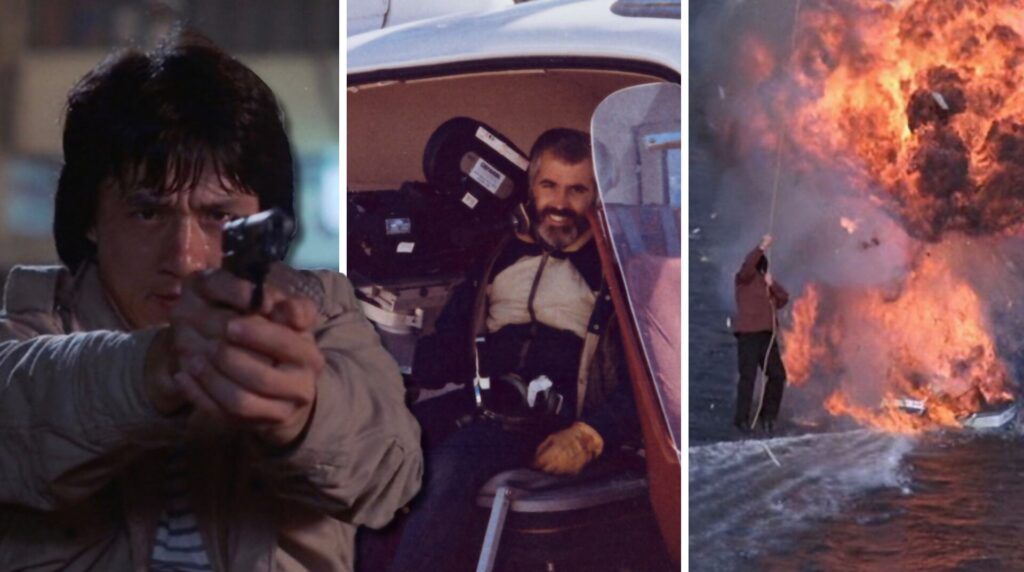

Cinematographer Mark Irwin recalls making The Protector – a Jackie Chan action thriller with two cuts, a dangerous stunt that almost went badly wrong, and a lot of sore backs.
“The hero boat is filled with explosives. The bad guy boat was filled with something called detcord, or primacord, which is what’s used to blow up buildings. This was an actual cabin cruiser. What could go wrong?” – Mark Irwin, cinematographer
Jackie Chan always wanted a hit in America. But while he was a massive star in Asia, his early 1980s attempts at adapting his physical action for US audiences hadn’t caught on.
The Big Brawl, written and directed by Enter The Dragon’s Robert Clouse, failed to turn Chan into the world-famous Bruce Lee successor that production company Golden Harvest had hoped he might become. Next, Chan joined road-trip comedy The Cannonball Run (1981) and its 1983 sequel Cannonball Run II, but these amounted to little more than cameos.
In 1984, however, work began on The Protector – an attempt to fuse Chan’s martial arts prowess with the grittiness of a New York police thriller like The French Connection. Chan was to play Billy Wong, a Hong Kong cop who, along with his partner Danny Garoni (Danny Aiello) attempt to smash a drug trafficking ring that takes them from Manhattan to the Far East.
To give the movie an authentically American edge, Golden Harvest’s producers approached New York filmmaker James Glickenhaus, who in 1980 had made a violent revenge thriller, The Exterminator. Initially, Glickenhaus said he wasn’t interested in making a Jackie Chan movie; he later said that he only agreed to do it on the basis that he had “total creative control” and final cut.
From the beginning, however, the east-meets-west production caused a certain amount of tension. With only a limited understanding of English, Jackie Chan struggled with the pages of dialogue; he also disliked the American way of shooting fight sequences, where there was little time to plan and rehearse.
In Hong Kong, Chan was used to spending weeks planning out elaborate patterns of kicks and punches; in the US, the stunt crews were used to bar fights with “John Wayne roundhouse punches,” as cinematographer Mark Irwin puts it.
Born in Canada, Irwin had begun his career just as that country’s film industry began to boom in the 1970s, with his early work including several of David Cronenberg’s breakthroughs, among them The Brood, Scanners, Videodrome and The Dead Zone.
By the mid-1980s, Irwin had moved to Hollywood – and found himself working on The Protector, which wasn’t exactly like anything he’d made before or since. Its 12-week shoot was divided between New York and Hong Kong, and Irwin recalls that, while Chan was talked into doing things the American way while he was in Manhattan, the star took greater control over the fights when the production moved eastwards, employing his own stunt team and generally giving the action a more Hong Kong feel.
What follows is Irwin’s fascinating recollections from that shoot, lightly edited for clarity and minimally interrupted with some explanatory text. It forms part of a broader conversation about Irwin’s extraordinary career in horror, action and comedy, which you can find in the new edition of Film Stories magazine, available to order from our online store.
If you like the anecdotes below, you’ll probably enjoy his memories of working with Cronenberg, Wes Craven and more besides.
For now, though, we head back to October 1984, and the filming of a complex, explosive action sequence on New York’s Hudson river which almost went drastically wrong…
The massive explosion, the emergency landing
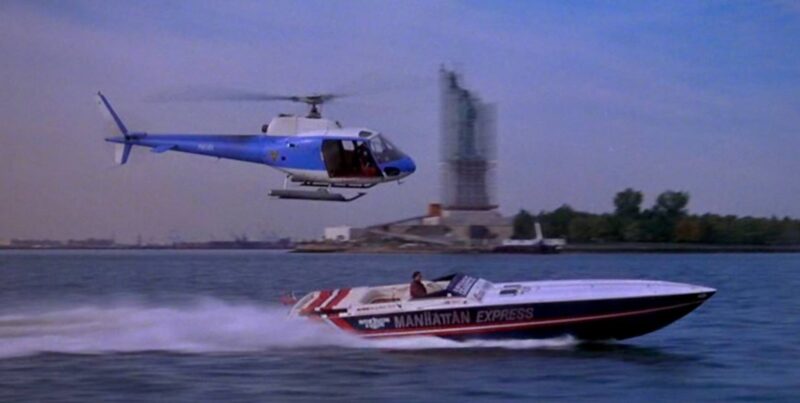
One of The Protector’s early set-pieces sees Jackie Chan’s Billy Wong hop into a speedboat (or ‘cigarette boat’ as they’re also called) to pursue a villain aboard a cabin cruiser.
Mark Irwin: Jackie was completely fearless in the sense that he’d never seen a cigarette boat. Most people hadn’t – it’s not like they’re down your local marina. But he got in and he just took off. He was supremely skilled in everything he did.
So this boat chase meant the bad guy got a head start, and Jackie was doing this flanking maneuver. He couldn’t shoot the bad guy, so he decided, ‘I’m going to ram this boat’. Crash. Explosion. Before the impact, he calls in a helicopter, holds onto a rope, he gets pulled to safety. Crash.
We set that all up, and then with the permission of the Coast Guard, the Harbor Police, the Staten Island Ferry – everybody was involved. This was shot on a Sunday morning at what is termed slack tide, and the Hudson River and the East River meet at the Battery, and that’s where we shot.
I spent a whole week ahead of time shooting this boat.
[This elaborate sequence required two helicopters – one for Jackie Chan’s stunt double to grab hold of, and one to capture the footage.]
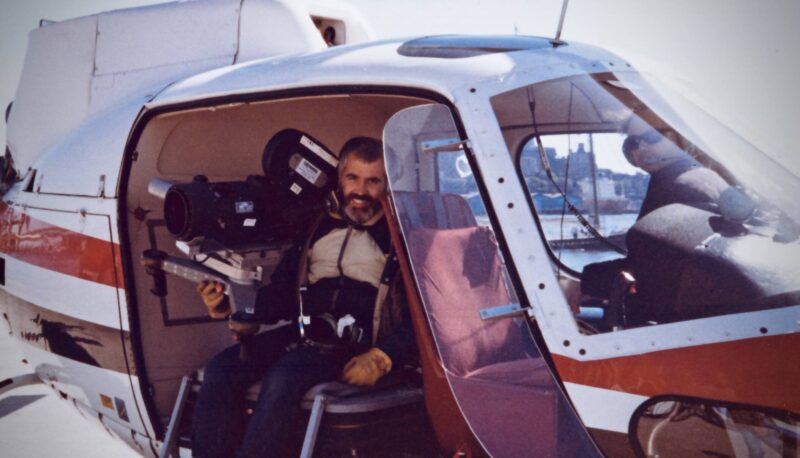
We were in a helicopter flown by a guy called Al Cerullo. So this Sunday morning, the conclusion to this explosion, we had five cameras, one of which was mine in the helicopter – the same helicopter with Al Cerullo.
Now Jackie’s character is hanging onto a rope underneath the police helicopter and swinging around.
The insurers and the producers, Raymond Chow and David Chan, would not let Jackie hang from [the helicopter].
[Actor and stunt performer Cheung Wing-fat doubled for Jackie Chan in the sequence where he dangles from the helicopter by a rope.]
The hero boat is filled with explosives. The bad guy boat was filled with something called detcord, or primacord, which is what’s used to blow up buildings. This was an actual cabin cruiser. What could go wrong?
We’re in the middle of the harbour, we’re in the helicopter, no problem.
The thought was that Jackie’s boat would be towed into [the cabin cruiser] by an anonymous fishing boat 1,000 feet away or something, so everyone would be safe. Fair enough.
We’re both getting into position. The Jackie helicopter’s below me, and there’s me in the helicopter above. We’re setting up this composition above the bad guy’s boat that’s going to explode.
[Somehow, a member of the effects crew made a mistake when rigging up the explosives. As soon as the wires running from the cabin cruiser were connected to a control panel, the detonation occurred right away.]
So the boat, five seconds ahead of time, exploded.
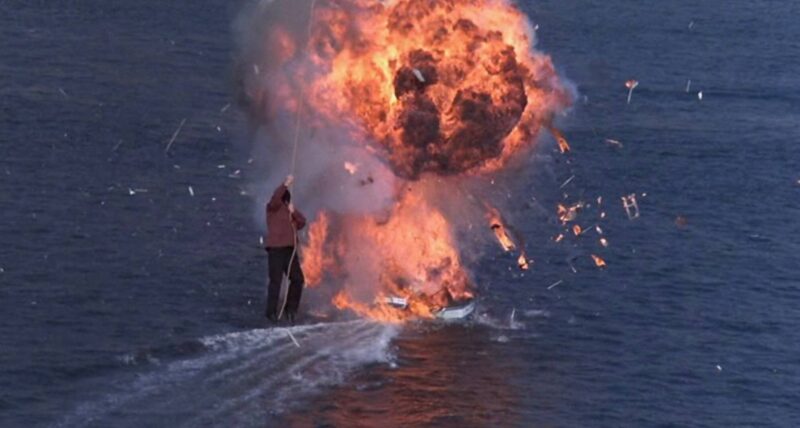
And it wasn’t styrofoam – it was wood, steel, aluminum, the whole deal, plus flames.
[Had the explosion occurred at the right time, the helicopters would have been at a safe distance. Instead, they were hovering right above the fireball and debris.]
So, instead of us being way up here, we were right there getting into position.
Bam, it blew up. Nobody was rolling. The only person who got the shot was the photographer from the New York Post or New York Daily News.
Their cover photo says, ‘Film Crew Goofs’ and shows this explosion with Jackie’s double, and my helicopter dangerously close.
Jackie’s stunt double was a guy called [Cheung Wing-fat]. Wing-fat went down in his helicopter – an autorotate landing on Ellis Island.
[An autorotation is an emergency move in which the pilot uses the upward flow of air to guide the helicopter to a safe landing.]
We went down in the South Island Seaport in Manhattan, where everyone on a Sunday morning – beautiful day out – is drinking lattes.
We didn’t have anybody hanging off the bottom, but an auto landing, a skid landing, is kind of scary to watch, especially if you’re in the way. And that’s what was happening.
That was not good.
They had a kind of barge, a party boat, where everybody was there with little tents. The whole deal: the producers. Everyone went ‘Uh-oh.’
And then the Coast Guard cutter pulls up, and the commander gets off. And then the Staten Island ferry guy. And the Harbor Commission comes. And they’re all around the producer, who was expecting the worst.
And all three of these guys said, “That was fantastic! We were on the Staten Island Ferry, waiting for it to leave, and five minutes earlier, [makes boom noise].”
They loved it.
The producer said, ‘Oh. Well, we need to do a take two. How’s next Sunday sound?’
So a week later, we blew it up for real, and nobody got hurt…
It was definitely a learning experience for everybody.
Hong Kong, and doing things the Jackie Chan way
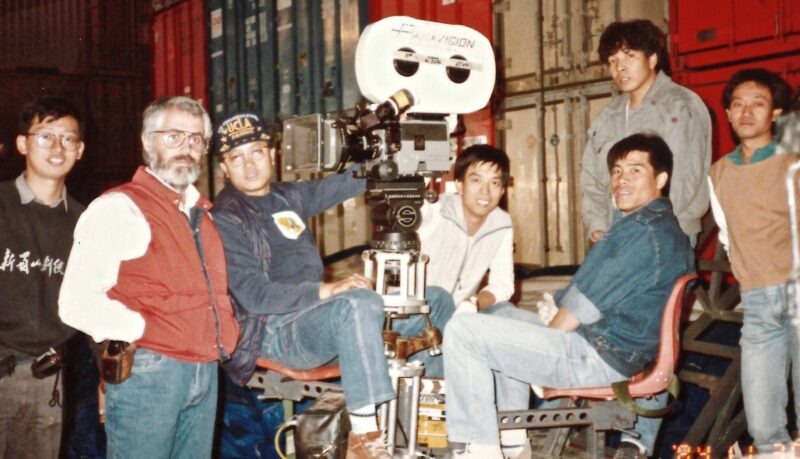
[With filming in New York complete, the production shifted to Hong Kong. On the first day of filming at Golden Harvest Studios, the team began working on a later sequence where Jackie Chan and Danny Aiello’s characters fight their way out of a massage parlour.]
Mark Irwin: So far, Jackie had done everything [the American way]. Two or three cameras, a stunt double, a spring board, everything measured, nobody got hurt.
Now, here we are in Hong Kong – in his domain. And we get in this little massage parlour.
It must be remembered that Jackie, in evey fight, fights the same seven to 10 people. They’re his stunt group. He would rehearse every fight with them, they put on a hat – fight, fight, fight. Next scene, same guys, different shirt, no hat, keep fighting.
By the end of the first week, I said, ‘Jackie, it’s not for me to say, but aren’t you aware of the fact that you’re always fighting the exact same people?’
He looked around and said, ‘We all look the same. Nobody knows.’
I said, ‘Okay.’
We shot the whole movie, and when you watch it, you can’t tell.
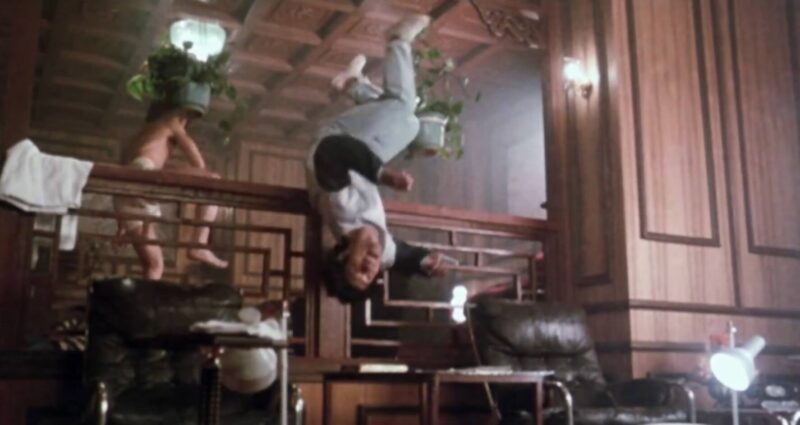
Now, he leaves the massage room, goes down a long hallway, and busts into another office. It’s on a double level, and he kicks a guy, who lands in a glass coffee table. He does this incredible jump-twisting thing, climbs up the wall, down again, kicks. That’s what was planned. It’s fantastic.
In this show, I had five cameras every day for 12 weeks – 60 days. So we had three cameras planned for this stunt, breaking a coffee table, all that stuff.
And Jackie, now he’s in his domain. “No, no. You don’t do that.’
‘Well, we’d done this last week in New York.’
‘Yeah, you don’t do that.’
Glick and I look at each other.
I said, ‘Jackie, how would you do this?’
‘One camera. I run down the hallway. Zoom in on the door. This [villain holding a ] club comes out, so zoom into me close…’
We realised this is how he grew up. Hong Kong style, no money, one camera, no dolly. Zoom, cutting in-camera. So everything was engineered to feed into that – not only the narrative, but that method. You don’t need a wide angle and two singles, just do the wide angle, cut, do the close-up, exit frame, new angle. Enters frame, turn, kick, cut.
They could do a whole fight scene in 400 feet [of film – or four minutes 26 seconds].
So that was the showdown to the director, to the producer, because you hired us to do this to give it an American feel. You thought that was the route to success. This is where you started, and you want to leave. What’s going on?
The final fight, and some sore backs
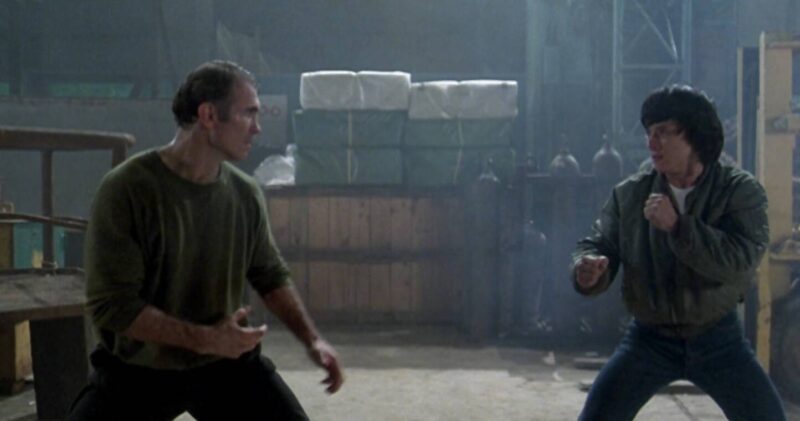
The Protector’s concluding showdown sees Jackie Chan fight the American martial artist Bill ‘Superfoot’ Wallace. By this point, Irwin had come up with a cunning plan: while he had a main camera capturing everything, as Jackie Chan had insisted, he also had other cameras dotted around, hidden from view. That way he could sneakily get extra footage he could cut together later.
Mark Irwin: Jackie has to do a fight where Bill kicks him and he lays out on his back. And everyone wears pads all the time.
He said to me, ‘I need three cameras.’
I said, ‘What? You’re asking for three cameras?’
I’d been hiding them, literally, behind sound blankets. Jackie would get kicked, I’d pull [the blanket] down, get the angle, hide it again.
He said, ‘I only want to do this once.’
It was his back – it was getting wrecked.
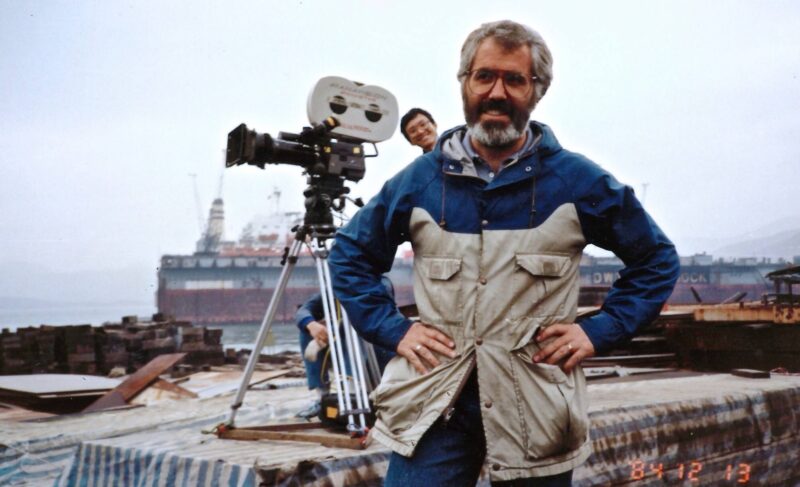
There’s the scene in the warehouse where one by one, bad guys come in. [Jackie] kicks them, and they fall onto the container below. That was the way that people got into his stunt troupe – his gang of eight or nine.
If there was some incredible or unpleasant hit – [call over] the new guy.
[In the finished film, you can see several stunt performers getting kicked by Chan and landing with a resounding thud onto the tops of cargo containers.]
They put on a chest pad and a back pad [on the stunt performer], and this guy would run in, Jackie would do some spinning kick, and then kick this guy. [The stunt guy would] fall, no [crash] pads, because it was all on camera. He’d hit this steel thing – boom, unconscious.
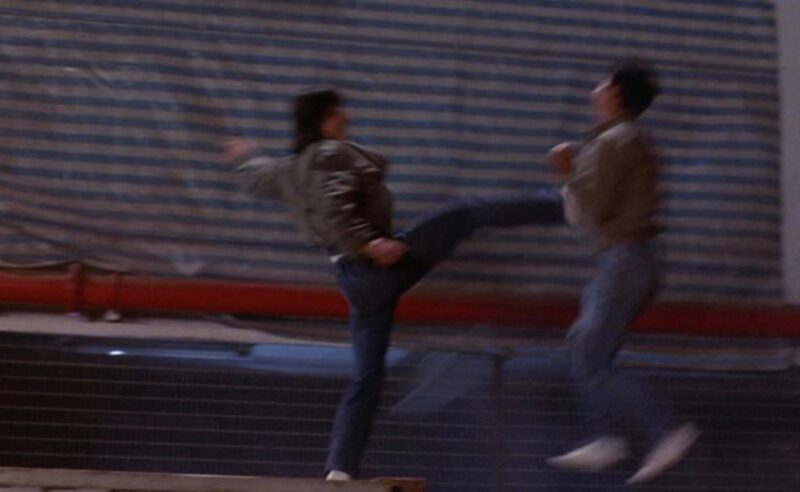
The crew would go down, take the jacket off, take the pads off, take him away in the stretcher. Next guy in line: take two.
So that was completely brutal, and that’s how they did it. There was no dynamic plan, no logistics. If you hit the ramp at 30 miles an hour, you land right there. You jump here, put the pad right there. Now, who wants to be in the troupe? Okay, here’s the ramp, here’s the pad. Action. Thud. Okay, move the pad. Next guy, thud. Okay, move it closer. Trial and error.
That was the way he did things, and that was exilarating in the sense that we’re working without a net at all times.
The two Protectors
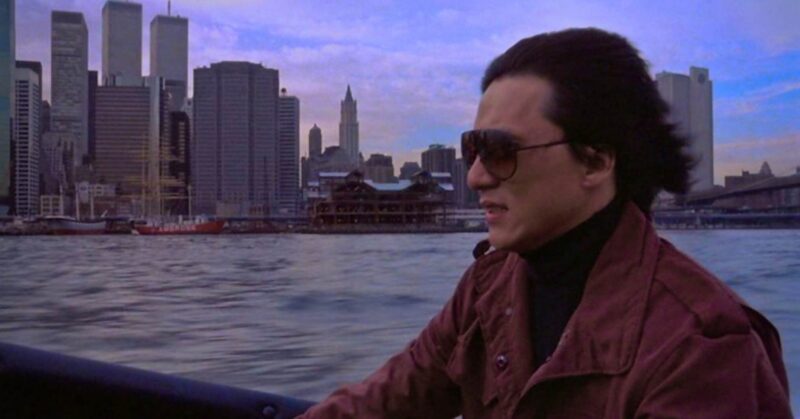
Dissatisfied with James Glickenhaus’s version of The Protector, Chan did something rather unusual: he oversaw a markedly different cut. Entire sequences were removed and new ones added, while much of the swearing and nudity in Glickenhause’s edit was also removed. As a result, Asian markets got a markedly different version of The Protector from the rest of the world.
Mark Irwin: Warner Bros paid $5m for the US rights, and Raymond Chow said, ‘Yeah, okay, great deal. It was cut in New York, I coloured it, timed it there, and it was released in North America, Canada. In Asia, they owned the rights, and Jackie went back to every location and reshot every fight, or added more scenes.
[Roughly three years later, Irwin was in Malaysia, shooting the war drama Bat*21, starring Gene Hackman and Danny Glover. He happened to stumble on a cinema that was showing The Protector. Curious, he sat down in a packed screening room – and only then discovered just how drastically the film had changed.]
It was easily 20 minutes longer. ‘I don’t remember that. I don’t remember that…’ Jackie had added all this material!
The (police) story continues…

Like The Big Brawl, The Protector failed to launch Jackie Chan into Hollywood superstardom, though it was still a big hit in Asia. But Chan’s frustration with its production led him to make his own take on the cop thriller immediately afterwards: 1985’s Police Story, which became one of the defining films of his career. A decade later, Chan made Rumble In The Bronx in 1995, which finally gave him the North American success he was after.
As for Mark Irwin? He remained busy making a varied mix of action, horror and comedy over the next 40 years – though he never made a martial arts film quite like The Protector again.
Film Stories issue 61 is available to order now. A sincere thank you to Mark Irwin for his time and access to some terrific behind-the-scenes photographs.