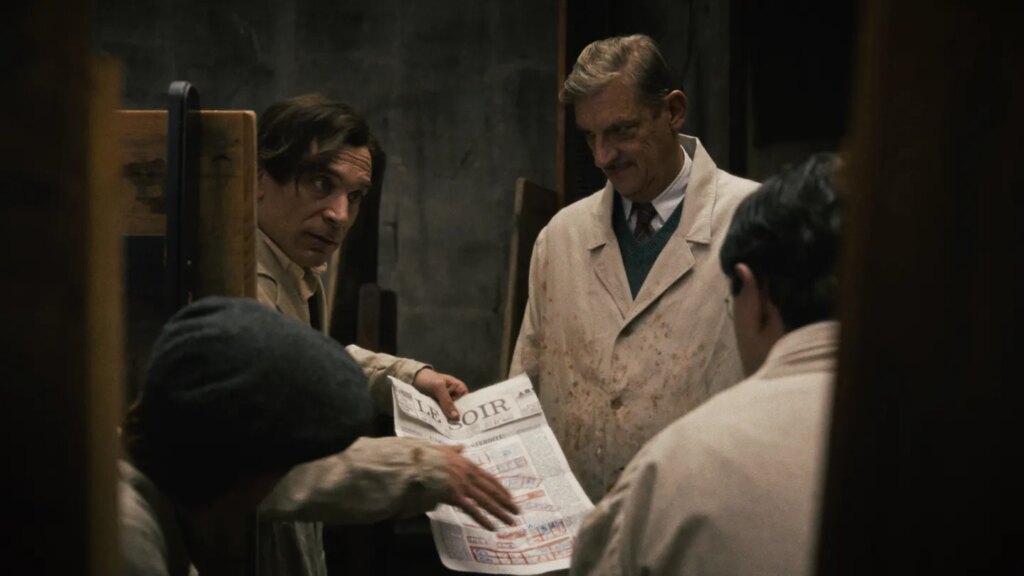

In November 1943, a group of Belgian journalists and printers pulled off one of the great stunts of the occupation: they intercepted the Nazi-controlled newspaper Le Soir (The Evening) and replaced it with a satirical counterfeit, Le Faux Soir (The Fake Evening), mocking the occupiers. It was the world’s first media hack.
In his film version, Belgian director Michaël R. Roskam (Bullhead, The Drop, Racer and the Jailbird) tells the story as a caper — “Ocean’s Eleven, but with a newspaper” — featuring a cast of Belgium and France’s funniest actors. Le Faux Soir has its world premiere at TIFF and is being sold by Goodfellas worldwide.
Roskam spoke to THR from Brussels about researching 1940s jokes and linotype machines, why authoritarians can’t stand being laughed at, and the limits of satire.
When did you first hear about Le Faux Soir, and how did you decide to make a film about it?
That’s actually my co-writer, Bernard Falaise. He’s about my age, and he decided that he wanted to do film studies, so he went back to university. At some point, he had this course about piracy in media and satire. In that course, they had been talking about Le Faux Soir. All of a sudden, their phones started buzzing — the ones who had them still active got notifications — it was the attacks in Paris, on [French satire magazine] Charlie Hebdo.
A year later they had a choice: either write a thesis or write a script. He wanted to write a script on the Le Faux Soir story. He came to me because we’re friends and he really helped me with casting on Bullhead. He’s French-speaking, I’m Flemish-speaking. He’s like, “Dude, I want to make the script. It’s tough. You want to give it a read?” And he told me the story, and I was like, “That’s a movie. This is amazing. I’ve never heard of it.”
No one on the Flemish side [of Belgium], with very few exceptions, had ever heard of this story. Even on the French-speaking side, it was mostly the subscribers of Le Soir, because every year they do a kind of article about it. I’m like, “Dude, if you manage to write this, I’ll direct it.”
So he tried, and his script was fairly cool. But I said, “You already told me the story, and I see images, how I would direct it, and your script is not what I see.” But I wouldn’t want to steal the project from him so I said “Let’s write it together, and I’ll direct it.”

Michaël R. Roskam talking with actors on the set of ‘Le Faux Soir’
Maxence-Dedry
What was the hardest thing about cracking the script?
The hardest problem was the text [of the fake newspaper] because the text is funny. It’s a satire. The text is funny, but the text is also old, it’s from the ’40s. A few of the jokes still hold up, but a lot of them refer to people or things where it’s more “I feel it’s funny, but I don’t get the joke, because I don’t know what they’re talking about.”
And I was way more fascinated in how they pulled the thing off. Because writing a satire isn’t the dangerous bit, it’s publishing it. How they did it felt to me like a heist movie. Ocean’s Eleven, but with a newspaper.
That’s what I said: we need to be very disciplined about the humor, to make it funny without making a satire movie, like Life is Beautiful — which is fantastic — or Taika Waititi’s Jojo Rabbit. I didn’t want to make a satire. I wanted to make a realistic movie about very realistic, very funny people risking their lives.
How did that shape the casting?
Even at the script stage, I said: “Dude, we need to cast people with funny bones.” I needed François Damiens, I needed Arieh Worthalter, I needed Bouli Lanners. They’re big names in the French-speaking community, the funniest guys on the planet. Bouli is funny and poetic. Arieh is a great, sensitive and funny actor. François Damiens is a funny clown who does everything to hide that he’s actually a fantastic actor. And then you have Mélanie Thierry, who is very poetic, serious, but she also has a little something, a twinkle in the eye. When I had my Ocean’s Eleven together, it was also about holding them back, or they’d turn the film into a full-blown comedy.
What’s compelling is that the heroes here aren’t the typical resistance fighters planting bombs. They’re people making jokes, puns and silly poems as a way to resist fascism.
I see this film as right in between something like Chaplin’s The Great Dictator and Inglourious Basterds. For me, it was not about doing what Chaplin does, making that kind of satire. It was about showing how Chaplin does it.
Michaël R. Roskam holds up a copy of the fake ‘Le Soir’
Guillaume-Van-Laethem
I’m a print guy, so I was geeking out on the mechanics — where they get the paper, the presses, how they copy it. How deep did you go into the research?
My way of working is to learn everything about the subject I’m making a movie on. From Bullhead, I still know how to raise cattle and bring them to the meat market, illegally and legally. I know the holdups I staged in Racer and the Jailbird would work in real life. Here, I know how to print a newspaper using 1940s technology. I could be a project manager of a newspaper in the ’40s.
I went to museums and started finding people, retired people in their 80s and 90s, who told me how it was. Then younger people who learned from the older people, who are rediscovering the old techniques. La Démocrate in France is a museum, but they still print a newspaper, La Démocrate, using the old methods. And they’re young guys. It’s so amazing.
Discovering the linotype was one of the most magical things I have ever encountered in my career. I don’t think I’ve ever seen a machine I didn’t know existed that is still alive only because of the passion of people keeping it alive. It’s literally a wonder. I still get goosebumps when I see it. I can look at it for hours. Just the sound of it. For your readers: the linotype is a machine that automates typing, where the letters are melted into a mold, instead of setting every letter by hand. It’s an automatic process, but still mechanical. It’s nothing digital. When I saw this, I knew: this is what we need. We need to evoke those moments.
There’s something about the physicality of it. If you were doing a story about social media satire today, visually you’d just have people looking at their phones.
Some little text appearing on screen, yeah.
What does this story have to say to audiences at this moment?
Well, the reason why we tell historical movies is always in the now, in the moment when you decide that the story is important. It came to Bernard at one of the craziest, most horrific events of the last 10 years: the shooting at the Charlie Hebdo editorial offices. This act of terrorism against satire.
And because of the issue of fake news. Fighting fake news today is dangerous, but during the Second World War, you could get a bullet in your head for making the wrong comment, the wrong joke.
I hope that young people will watch this film with their grandparents, and see that there have always been people fighting against fake news, against how the truth has been bent throughout history. It was done with weapons and violence, but very often it was also done with words. One of our characters says: “Why do the Nazis burn books? Because words are weapons.” And he means it. It’s always been like that with satire. It’s like making fun of the king. It’s forbidden, but it’s the only way you can hurt him. That’s what I wanted to do.
Although it’s almost ironic that today, so much of the spoofing is coming from authoritarian regimes. Russia famously has farms that copy Le Monde or Der Spiegel — the exact websites — and promote their own fake news within them. They’re doing exactly what Le Faux Soir did, but for the opposite purpose.
Exactly. Isn’t that ironic? If an alien were to look from space at the modern day, he might think that we, the establishment, are the Nazis of the time, and that the ones on the right hacking us are the resistance of the ’40s. We’re defending democracy, but there are some people who are victims of that situation, and they want this system to be dismantled, and they’re using everything they can.
I believe that I’m fighting for the right thing. I’m for democracy. But I don’t know. Maybe I’m on the wrong side. I don’t know. It’s a terrible thought to think that I’m on the wrong side, man.
It also raises the question of how effective satire really is against authoritarianism. Those famous Berlin cabaret artists who mocked Hitler were all either shot or exiled. Le Faux Soir doesn’t topple the Nazis either. The satirists are rounded up and shot.
Satire is not like blowing up a bridge. But if it works, if you can make it work, you can plant the seeds in the heads of the people. It has a toppling effect.
Satire has a mental effect. It is the first button of the emperor’s clothes being opened, and then the next one. And if you continue doing it, at some point he’s naked on his throne and everybody’s laughing, and that’s when he loses. That’s why authoritarian regimes hate satire. They can’t stand it. They come back with falsification, with fake news, which is not the same as satire.
This interview has been edited for length and clarity