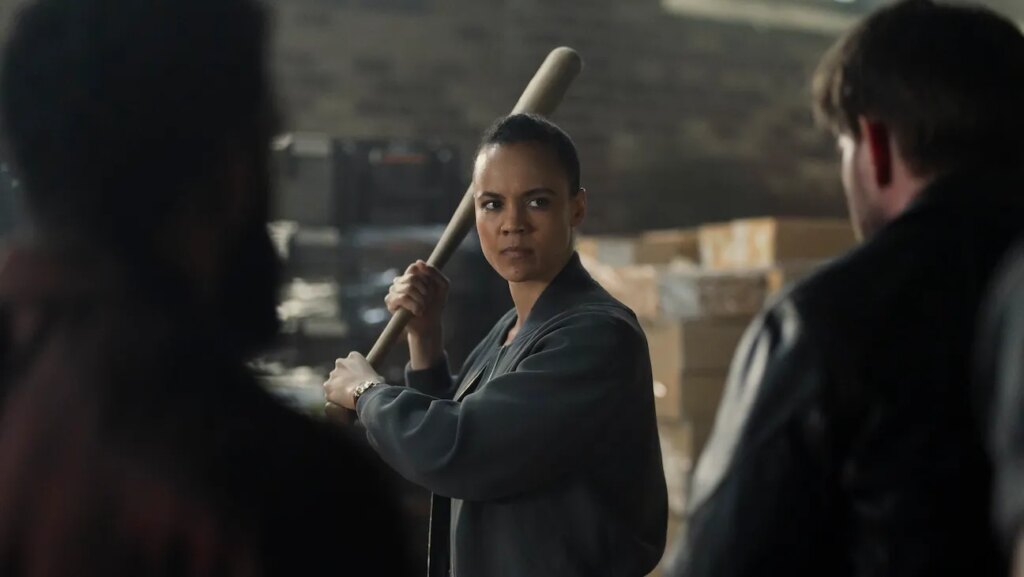

In Lee Child’s ongoing series of novels focused on outsized American ronin Jack Reacher, Frances Neagley is perhaps the character Reacher trusts the most and — in a franchise whose protagonist wanders the country picking up only a small selection of new allies in each installment — one of the few to recur across 30 books.
Still, her presence is only occasional, since Reacher’s lone wolf status is nearly as important as his size. If Reacher needed Neagley as part of every adventure, the series would be Reacher & Neagley. It is not.
Neagley
The Bottom Line
Thrives on action, stumbles on exposition — just like ‘Reacher.’
Airdate: Wednesday, September 16
Cast: Maria Sten, Greyston Holt, Jasper Jones, Adeline Rudolph, Matthew Del Negro, Damon Herriman, Alan Ritchson
Creators: Nick Santora, Nicholas Wootton
In adapting Reacher for television, though, Nick Santora made Neagley (played by Danish actress Maria Sten) into a much more integral part of the mythos, working her into the first three seasons and then, not exactly surprisingly, giving her a spinoff series. (It was announced in July that Child and collaborator Yasmin Angoe will publish at least two Frances Neagley novels as well.)
Neagley, developed for TV by Santora and Nicholas Wootton (Child was sensible enough to make his primary partner on the book series a woman of color, while Santora… did not make a similar choice), arrives precisely as the fourth Reacher season is wrapping up on Amazon.
The two series are not narratively connected, though Alan Ritchson makes multiple Neagley appearances so that Reacher can give Neagley his blessing to have her own onscreen existence.
They are, however, qualitatively connected in the sense that Neagley is, like Reacher, inextricably dependent on the screen presence of its star and probably asks more of Sten as an actor than Reacher has ever demanded of Ritchson, who has always been excellently and purposefully monotonous. More than that, though, Neagley follows in its predecessor’s footsteps by being a satisfying series when it keeps its focus on well-executed action beats, but becomes tedious and, at times, close to unwatchable when the focus shifts to plot and demands exposition.
I’ve thought that each Reacher season was a perfect six-episode season padded out to eight episodes with rarely-successful filler. Neagley is the same. Sten anchors the series well and Neagley has been surrounded with a likably evolving ensemble, but the second half of the season, especially the sixth and seventh episodes, get bogged down in the increasing ridiculousness of the season-long arc, as well as a highly questionable attempt to flesh out its hero’s backstory.
After a prologue featuring the first of Ritchson’s brief appearances, the season functionally begins with a dazed young man stepping off a platform on Chicago’s L and walking toward an oncoming train and his death.
The young man turns out to be Tommy (Jhaleil Swaby) and Tommy turns out to have been a childhood friend to one Frances Neagley, the only family she ever knew other than her ailing ex-cop father.
Neagley works out of a bustling Chicago private investigations office despite not being a team player. She’s good enough at her job and brings in enough money that her boss has little choice but to acquiesce when Neagley decides to investigate Tommy’s death on her own.
In no time, Neagley’s snooping puts her in contact with Hudson Riley (Greyston Holt), a Chicago PD detective with a checkered family history, and the mononymous Keno (Jasper Jones), a resilient young street urchin with a long record of crime-adjacent activity and a connection to Tommy’s death.
Forced into an uncomfortable partnership with Riley, Keno and Renee (Adeline Rudolph), receptionist at the PI office, Neagley makes her way to Echo Canyon, a farming community just outside of town. Echo Canyon sells fresh produce at Chicago street markets, but the farm is operationally closer to a wellness cult, under the spiritual guidance of Lawrence Cole (Damon Herriman), an English professor turned folk singer turned guru, whose primary business is being carried out in a heavily secured barn monitored by pharma executive Pierce Woodrow (Matthew Del Negro).
Neagley served under Reacher with the 110th military police, and she shares her mentor’s keen powers of observation — but also his refined sense of justice, which often intersects with vengeance. She talks tough, thinks nothing of resorting to torture and is amply physically capable in a fight, but she lacks Reacher’s daunting physicality. Instead, Neagley has exceptional dexterity, which Sten captures well, plus she’s a convincing onscreen runner, which cannot be said for Ritchson, who has committed so thoroughly to Reacher’s Mack truck presence that he often seems incapable of moving like an ordinary human.
With Santora steering the storytelling, plus a directing team led by Reacher veterans Sam Hill, Gary Fleder and MJ Bassett, Neagley looks and feels like Reacher, right down to the way its chosen location (Chicago) generally looks more like the place it was filmed (Toronto). One quickly forgets that fact when people are getting punched in the face.
The first Neagley season starts off familiar and gets increasingly dumber, hitting a nadir in the penultimate episode before the finale turns its attention to blissfully cartoonish badassery — including an obligatory scene in which our main characters walk away from an exploding building in slow-motion as if this were a wholly original visual idea. Sure it’s a cliché, but it’s an enjoyable cliché.
The most distinctive thing about Neagley as a person is her haphephobia, or her fear of being touched. On the page, it’s a disorder that exists more than anything as an explanation for why Reacher, an unapologetic man-whore who sleeps with roughly half the introduced female characters, and Neagley have a relationship that’s entirely platonic. Readers have theorized that Neagley (and Reacher, for that matter) is perhaps somewhere on the autism spectrum and/or that her phobia has its origins in a traumatic backstory, but Child has gone out of his way to avoid spelling anything out.
Rather than exploring new elements of Neagley’s personality or leaning into the psychological uncertainty, the series steers aggressively into the origin story for her haphephobia. Treating Neagley as a character fundamentally in need of solving is the sort of thing that books, TV shows and movies do much more frequently when it comes to assertive and strong women than men — as if a man could become Reacher-esque by virtue of size and training, but a woman would only become Reacher-esque through trauma, which plays a pervasive and frequently coincidental role in most of the season’s stakes.
The solving of Frances Neagley is so psychologically simplistic that it made me yearn for the previous “draw your own conclusions” approach, because the things we learn about Neagley make her more obvious and self-consciously “written” instead of more complex and human. At least the writers understand that “solving” Neagley isn’t the same as “fixing” her, though separating those sides of the coin just means that we’re looking at additional seasons that dwell exclusively on this one part of her past and personality.
The trauma is predictable and perfunctory, but at least Sten plays it well, digging beneath the character’s robotic exterior. Sten and Holt, playing Riley as a man whose polish and decency are an overcompensating response to how the world treats his origins, have good chemistry, which produces its own uncomfortable beats. Explaining Neagley because you want viewers to understand and empathize with a character is one thing. Explaining Neagley because you want the character to be part of a formulaic flirtation is less creative and less satisfying.
Jones, who resembles several of the young stars of Stranger Things to a distracting degree, adds some matter-of-fact humor and pairs extremely well with Rudolph, who makes Renee’s transition from background extra to supporting contributor to assertive and versatile action co-lead much more believable and organic than anything suggested in the writing.
Herriman is one of those great supporting actors whose presence I generally relish, but if you’re using a cult compound as your primary adversarial setting, going with a performer who has played Charles Manson on multiple occasions is not a way to avoid charges of familiarity. Herriman plays slick and slimy and persuasive extremely well, but Lawrence Cole is exactly what convention leads you to expect and Herriman hasn’t been given any variations of note. It’s the writing that also undermines my two favorite supporting performances from the farm, by Rebecca Liddiard as the leader’s right-hand woman and Jessica Clement as a glassy-eyed cult neophyte, both characters hinting at interesting wrinkles before going to either predictable or illogical places.
Storytelling missteps aside, Neagley promises pulpy, action pleasures and, by the end, achieves though never exceeds those expectations. It won’t fully work for viewers whose exclusive reason for watching can be boiled down to “Very Big Man Punches Stuff,” but it’s a generally entertaining potboiler of the sort that Amazon does frequently and well enough.