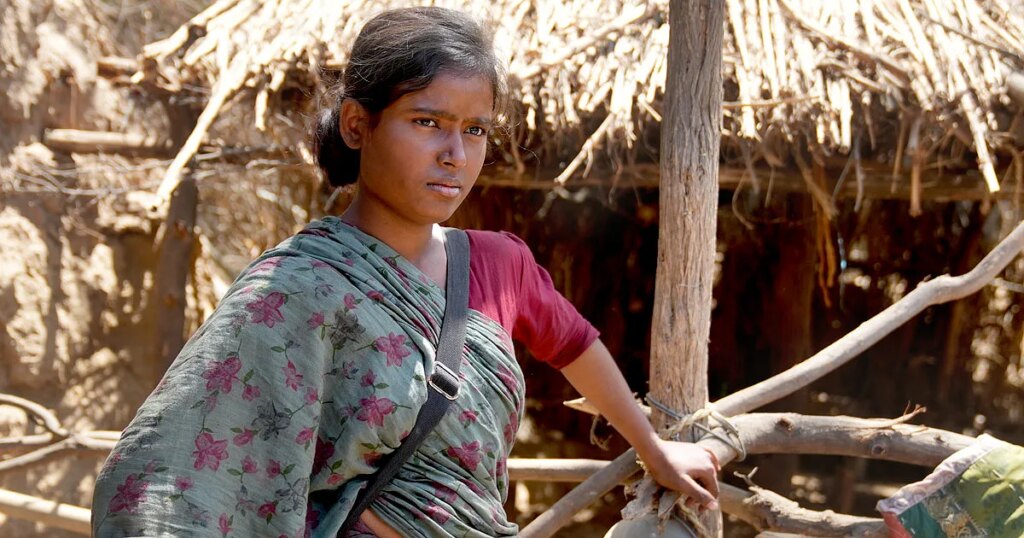

‘It’s a harrowing book because in the first 100 pages, you have the first-person account of a very young girl being abused. It’s an important, crucial document from her point of view, but impossible to emotionally endure if one is to illustrate it on screen.’

IMAGE: A scene from Phoolan.
Key Points
- ‘We literally have 2,000 men trying to obliterate this girl in this siege. I looked at this and I said, ‘I have never heard anything like this anywhere in the world in recorded history.’
- ‘I worked on Delhi Crime for six-and-a-half years. The victim of that crime stayed alive for two weeks and then gave her dying statement. I believe from her point of view, she would have hoped that things would change and the statement was enough to convict her perpetrators.’
- ‘To depict an event which is jaw-dropping from the fact that it’s just a gender war or in the context of India, but in the context of humanity. And to come out of that with compassion, from where this story starts and where it ends, and me not fabricating it, I thought could be very special today.’
Canadian-Indian filmmaker Richie Mehta‘s films are wrapped in deep sense of compassion for his protagonists, right from his first feature Amal (2007) and later Siddhartha (2013), to his OTT series, the International Emmy Award winner Delhi Crime (2019) and Poacher (2023).
His latest work is a riveting and gripping account in the life of Phoolan Devi, the 48-hour period when the rebel and her two supporters were surrounded by a 2,000 strong police force. The film Phoolan, is based on her autobiography I, Phoolan Devi: The Autobiography of India’s Bandit Queen.
Phoolan should not be confused with Shekhar Kapur’s film Bandit Queen (1994). Mehta’s film is an entirely new take on Phoolan Devi’s life.
Phoolan, starring first-time actress Sneha Kumari in the title role, premieres at the Toronto International Film Festival on September 16. The supporting cast includes Anurag Thakur and Vikram Pratap Singh.
“I wouldn’t be here if it wasn’t for Bandit Queen. It was my entry into discovering who Phoolan Devi was,” Richie Mehta tells Aseem Chhabra.
I believe the producers had brought Phoolan Devi’s autobiography to you and after reading it, you decided to pick this one chapter. Can you explain why this chapter spoke to you?
Why you felt it was the most important part of the book and how the larger story of Phoolan Devi could be narrated through this one particular incident? You do go back and forth with flashbacks.
I wouldn’t say it’s the most important part of the book. But it certainly was for me, as I was exploring whether to direct the film. Initially, I was unsure if I was the right person to do it. I kept saying I am a man, a Punjabi NRI.
I don’t see the context of why I should be telling this story. But the producers insisted that I was the right person.
It’s a harrowing book because in the first 100 pages, you have the first-person account of a very young girl being abused. It’s an important, crucial document from her point of view, but impossible to emotionally endure if one is to illustrate it on screen.
I also felt it was important that we should not sexualise her. That goes against the whole point of making the film. And we should not show her as a victim because that’s not what she was.
In my view, she was empowered. She was somebody who found agency in impossible circumstances. I started to think more about how we were going to make the film if we were going to tell the story in the context of today.
How are especially younger viewers going to want to watch this? If I do an art house film or series, I am not going to hold them. How can I convince them to want to engage with his harrowing story?
So I decided that the best way to do that today is to use all the tricks of drama that I can — tension and action — without embellishing her life. We had to be true to her life.
That’s why I zeroed in on this chapter of her life. Because as I read it’s one incident after another, shocking and appalling. Somehow she endures and then she perseveres through all of this. She describes it in an almost nonchalant way as just another incident in her life.
We literally have 2,000 men trying to obliterate this girl in this siege. I looked at this and I said, ‘I have never heard anything like this anywhere in the world in recorded history. And I believe it could be depicted in all of its details. She describes the incident cinematically, and by doing so, we would satisfy the things I wanted to do with the story.’
I believe it’s a very effective illustration of the world she was in. Without getting into the mechanics of all of the awfulness that happened to her, this simple premise of 2,000 men trying to snuff out a 17-year-old girl and they can’t because of her spirit, would make the viewer — anywhere in the world — understand what she was up against.
‘They were denied water. It’s a tactic of war’

IMAGE: A scene from Phoolan.
I have seen all your works. Your works have been much quieter. Perhaps the only exception is Delhi Crime. You haven’t done action like this. I am curious how you approached the action sequences.
I am sure there are scenes you developed at the script writing stage because they were not exactly written in that way in the book. She didn’t describe every moment the way it was filmed. But in writing the screenplay, how did the action scenes come about?
I use the pillars that she described. At one point, she describes over and over, ‘We would duck and evade, duck and evade, and there would be shoot out.’
She described the days and nights.
There was even more strangeness she described that I had to actually editorially remove. There was one scene where she climbs over a little fence with her gang at night, comes upon a compound where a bunch of soldiers are just having a smoke and hanging out. Because of the darkness, the soldiers couldn’t make out that these were their targets. They would just slink away in the darkness, but sit as if they were soldiers. We even shot that, but eventually we cut it out.
So I just tried to build a narrative around what she described. I figured each scene has a beginning, middle and end, as do moments in life. How do you get into these circumstances? How do you get out? She described people kept dying. And I obviously showed crossfire.
There’s an incident inside a well which was actually not from that siege. It’s from a different siege later in the book, which I took and put it here. So I took some incidents in different parts of the book that were as harrowing, and placed them in because several times, she describes hiding in wells. Then of course, I made up the flashbacks with other moments in her book. I didn’t fabricate anything.
She described the crux of that siege being she just needed water. They were denied water. It’s a tactic of war. So I started to formulate that is her goal in life. It becomes an interesting allegory for her to just try and reach the river, which also incidentally is the happiest place of her life.
In the prologue, when she is playing with her sister, she describes that, and so I felt that there was a symmetry that started to come by depicting the siege. We get a snapshot of the person she was before all this began, and the life she wishes she could lead.
I was thinking of Butch Cassidy And The Sundance Kid because of the shootout scenes. Did you watch other films like that to frame and make your script tighter?
I remember all those films, so they were probably in my mind. There were a handful of films I watched. The one that probably influenced me the most is Gallipoli.
I have seen Peter Weir’s Gallipoli (1981).
It was a war film that wasn’t a war film. It was actually a war film about compassion. Essentially, I thought, that’s kind of what I am doing here. If this magic trick could work, I set it up as a combat film, and then it starts to morph into something else as the film unfolds.
‘I wouldn’t be here if it wasn’t for Bandit Queen’

IMAGE: Richie Mehta.
Have you seen Shekhar Kapur’s Bandit Queen?
My first introduction to Phoolan Devi was through that film. I first saw it probably in the mid-2000s. That film attempted to cover most of her life, from childhood to surrender. So in a way, it’s been covered on film. But the point was not to remake a film that’s been done. It was to look at this new text, which is an autobiography that she dictated.
I didn’t feel it was appropriate to tell her whole life story. As I said, when I was reading the autobiography that was handed to me, I looked at her words and thought narrating a biopic from A to Z wouldn’t serve younger audiences today. I think this had to be about something else, something that’s relevant to the world today.
So it had to have a very different slant to it. I was not interested in retreading what’s been done.
I have to say again, I wouldn’t be here if it wasn’t for Bandit Queen. It was my entry into discovering who Phoolan Devi was.

IMAGE: The Phoolan poster.
What do you want the audience to take away from this film? Why is it important for us to revisit Poolan Devi’s life?
I worked on Delhi Crime for six-and-a-half years. The victim of that crime stayed alive for two weeks and then gave her dying statement. I believe from her point of view, she would have hoped that things would change and the statement was enough to convict her perpetrators. And then, she was no longer with us.
Then fast forward a few years later, and in my view, things have not gotten better. That example of someone like Nirbhaya and the courage she showed was starting to plague me.
Also, I am a father of two daughters. I was haunted by the thoughts that the world was getting worse, and there is a regression in this gender issue that we are seeing right now.
So I said, maybe it is time to show a much more biting, a much more direct, angrier version of this story. But I also felt expressing anger or outrage is never useful on its own. This is when I connected with the Constable Vijay character, which Anurag Thakur plays in the film.
When I was doing research on this version of the story, I went to the real village where the incident occurred and spoke to people above the age of 50. I asked them if something happened here in 1981.
This was a massive assault but there’s no account of it except in her book and in the villagers’ stories, in their collective memory.
All of them confirmed another detail: They told me about this one male cop who stood up against the injustice and what this male cop did at the end. It wasn’t in her book.
I said, ‘My God, there was one person out of those 2,000 cops.’ I don’t know who this person is. I don’t know if he will ever come out. But if I can construct this story now with Phoolan as the spine, the heart and soul, and this person (Constable Vijay) as our way in, I am not setting out to demonise all men.
To depict an event which is jaw-dropping from the fact that it’s just a gender war or in the context of India, but in the context of humanity. And to come out of that with compassion, from where this story starts and where it ends, and me not fabricating it, I thought could be very special today.
Photographs curated by Manisha Kotian/Rediff