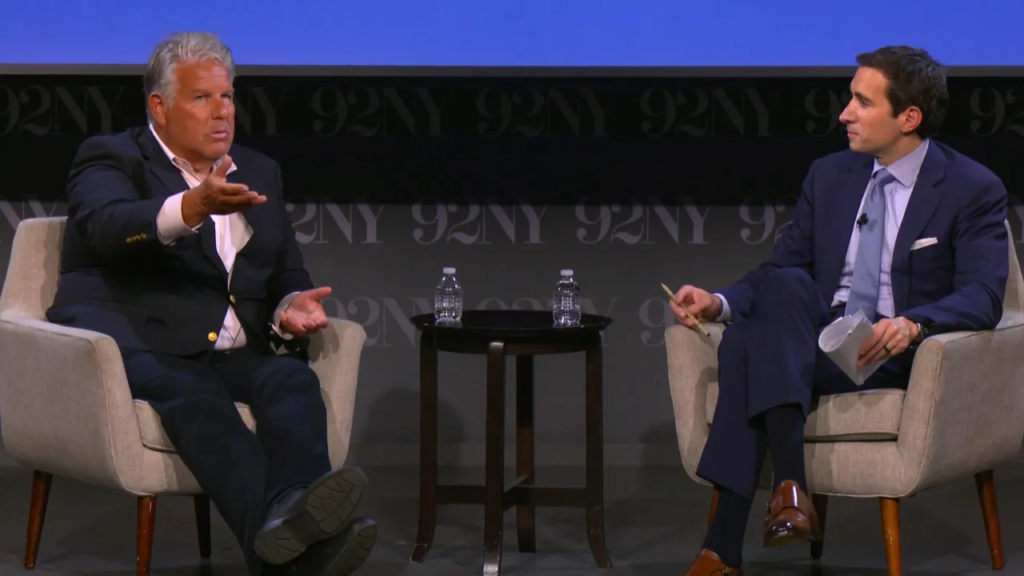

“Maybe this is going to be complicated because I work for the New York Times,” Sorkin acknowledged, but he wanted to know about Black’s criticism of the Times’ reporting in Cohan’s book. “Guess what?” Cohan said. “He didn’t like being accused of nefarious criminal activity on the front page of the New York Times.”

“But it turned out to be true,” Sorkin said.
“What turned out to be true?”
“The money, the women, all of the pieces that were published.”
“It is true that he paid $158 million to Jeffrey Epstein,” Cohan said. “He thinks it was for tax and business and estate advice.”
After a half-hour of this dance, Sorkin let Cohan move on to the book’s other, perhaps drier portions—as several of Money to Burn’s reviewers noted, Epstein’s name doesn’t appear until after the 400-page mark. When the discussion concluded, two security guards ushered Sorkin from the venue to a taxi, and I canvassed some of the attendees about the answers they were still looking for.
“Obviously [Black] believes what he believes and it’s up to us,” said Henry Seth, a manager for travel services at American Express. “We’ll never know what actually really happens.”
“I think it’s a little fishy in that there’s a lot more wrong,” Seth’s younger sister, Ryan, added.
Catherine Ramsdell, a veteran of four financial firms, described herself and a friend who accompanied her as “artifacts of the old Wall Street.” She grew up in Hanover, New Hampshire, where she said “the Dartmouth community is pissed as shit.” (Students have called for Black’s name to be taken off the college’s art museum, and Cohan said on Wednesday that the financier’s family foundation is having trouble giving $1 billion away. The foundation didn’t immediately return a voicemail seeking comment.)