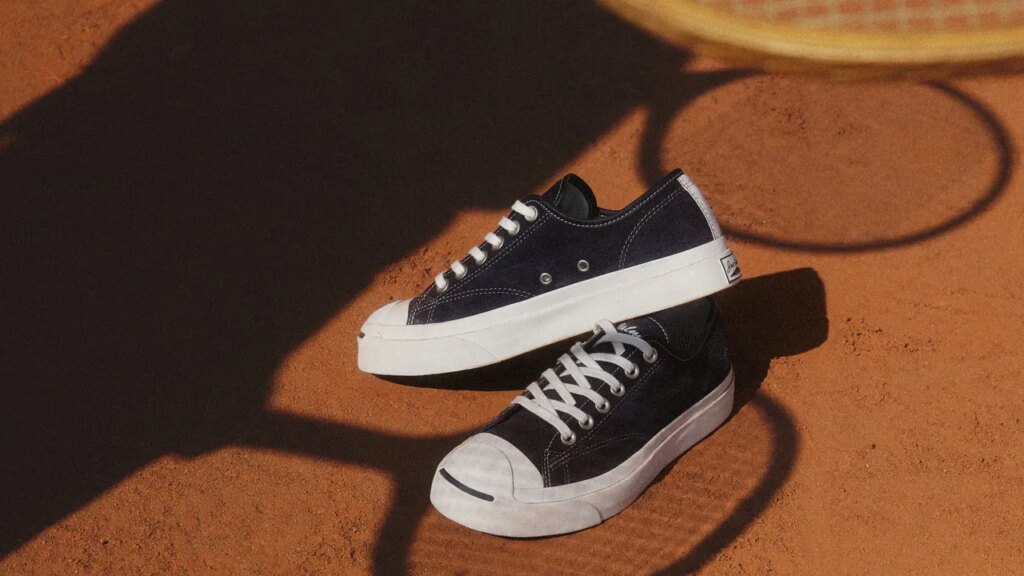

Picture Kurt Cobain. He’s got the floppy blond locks, the striped tee, beat-to-shit jeans, maybe a flannel. Now look down. What’s on his feet? You’re probably imagining Chuck Taylors, of course, the quintessential sneaker of disaffected youth everywhere. But look closer at some of the most iconic photos of Nirvana, and you’ll spy a subtle detail you probably never noticed before: the “smile” on the toecap of Converse’s other canvas lace-up, the Jack Purcell.
I’ve worn Jack Purcells on and off since my teens, and yet this revelation still floored me. Back in the aughts, JPs were marketed to kids like me as the preppier, peppier alternative to Chucks, a little sleeker and cleaner cut. Growing up in Toronto, I liked them because they were the OG Canadian signature shoe—Jack Purcell, the man, was a 1930s badminton champion from Guelph, Ontario—and because they worked as a “nice” option when my trusty checkerboard Vans felt too cooked for family dinners out. As much as he loved to subvert expectations in grandpa cardigans and Aubrey Hepburn shades, the idea that someone like Kurt Cobain was thrashing across the stage in yuppie court shoes would never have occurred to me.
“The way it’s been told to me is that he loved the smile,” Matt Sleep, Converse’s global design director, tells me of Cobain. “He was very much ahead of his time in the way he styled himself, and I think he liked how that little weird detail looked juxtaposed with his ripped jeans and printed shirts.”

As it turns out, there’s a whole lot of Jack Purcell history that somehow missed me. James Dean wore ’em. So did Elvis. George Harrison laced up his pair for the Apple Corps rooftop show. And while I’d always pictured Purcell himself as a square in pressed khakis, Sleep assures me he was the Andre Agassi of his day. “He was that level of iconography and in some ways notoriety as well,” Sleep says. “He was very charismatic on the court, but Jack had bags of personality off it as well. And people loved him. I think the kids call it ‘rizz’ now, don’t they?”
A lot of the JP’s rebellious spirit had long been swept under the rug as Converse positioned the sneaker as its grownup model, the one you could reasonably throw on at the office with a linen suit. But after a few years of relative dormancy—and with racket sports suddenly surging in popularity again—the Jack Purcell is in the midst of a major relaunch. Which means it’s Sleep’s job, in part, to help bring the shoe’s countercultural bonafides back to the fore. “We’re seeing fashion and other subcultures really look to tennis and court sports again,” he says, “and we’ve got a hugely legitimate heritage within that world. We’d be doing ourselves a disservice if we didn’t get to tell that story.”
One big way Sleep and team are hoping to restore the Jack Purcell to its former glory? By fully remastering the silhouette itself. While the model’s revival kicked off last week with the ultra-luxe First String iteration, today Converse is unveiling the version real heads have been waiting for: the Jack Purcell PDM, which draws on design elements from nine decades of archival kicks to deliver the definitive take on the shoe.