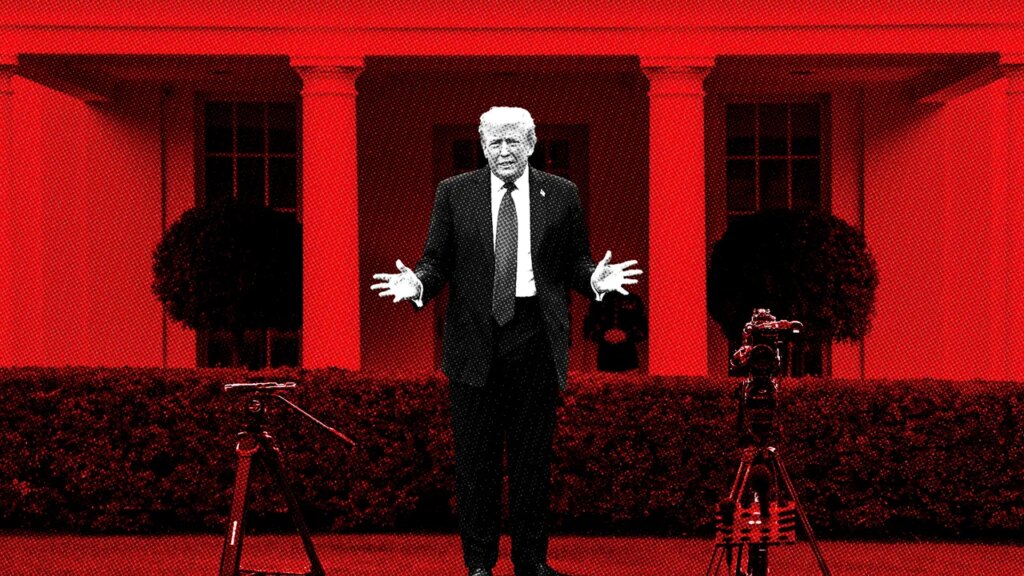

On Pebble Beach, the strip of broadcast booths that line the driveway leading up to the West Wing of the White House, you typically find some of television’s biggest stars, standing erect atop little wooden boxes, the glow of the camera light dancing off their thick coats of makeup, readying themselves to deliver a hit with the most famous building in the world as their backdrop.
This week, many of those booths sat empty, rain lashing the hunter green tarps that covered them, as President Donald Trump’s ban of three news outlets from the White House metastasized into a broader boycott by the press. It was unseasonably quiet inside the cramped press rooms of the White House, which are typically bustling with journalists awaiting the next hit or the daily briefing, though the latter hasn’t happened with much regularity as of late.
On Wednesday, two bored members of the press corps sat in the briefing room and debated the timing of the court hearing on the challenge to Trump’s ban. A young press aide walked into the room and complained about her cell reception. “Why do I never have service in my office?” she asked no one in particular. “It must be China.” Raghubir Goyal, an eccentric veteran of the briefing room who serves as White House correspondent for India Globe, a newspaper that appears to no longer exist, stood at the press secretary’s dusty podium and filmed selfie videos.
Earlier this year, Trump barred reporters from “upper press”—the rooms down the hall from the Oval Office that house senior communications aides—which has made the West Wing a considerably less valuable place for reporters to be. “You can’t go into upper press and talk to someone with authority,” says one White House reporter who now prefers to make calls from his members club.
Trump announced the decision to ban the three outlets—CNN, MS Now, and Politico—abruptly, without warning some of his top staffers. A White House official, declining to be named, tells Vanity Fair: “Nobody close to the president was surprised at his action to hold the fake news accountable.” Susie Wiles was miles away from Washington when it was decreed on Truth Social, and those left at the White House on Friday afternoon scrambled to figure out how to implement the president’s order. Some aides advised against the revocations, I’m told, warning it would have unintended consequences for Trump’s coverage. He ignored them. (Vanity Fair has reached out to the White House for comment.)
The hastiness helps to explain why the administration’s defenses of the order varied so exotically. It’s “a ban on the free press,” Trump said in the Oval Office. “We are banning them, yes, we are.” Clear enough. No, wait, here’s the vice president: “He’s not banning media outlets.” JD Vance went on to blame the ban that is not a ban on biased coverage. “About 92% of the stories that they have on the president of the United States, on the administration, are negative,” he reasoned. The White House, in its own statement, said Trump was banning outlets “friendly to the Radical Left.” Then, in a court filing, Trump’s Justice Department argued the trouble was not bias but that reporting from these outlets posed a threat to national security.