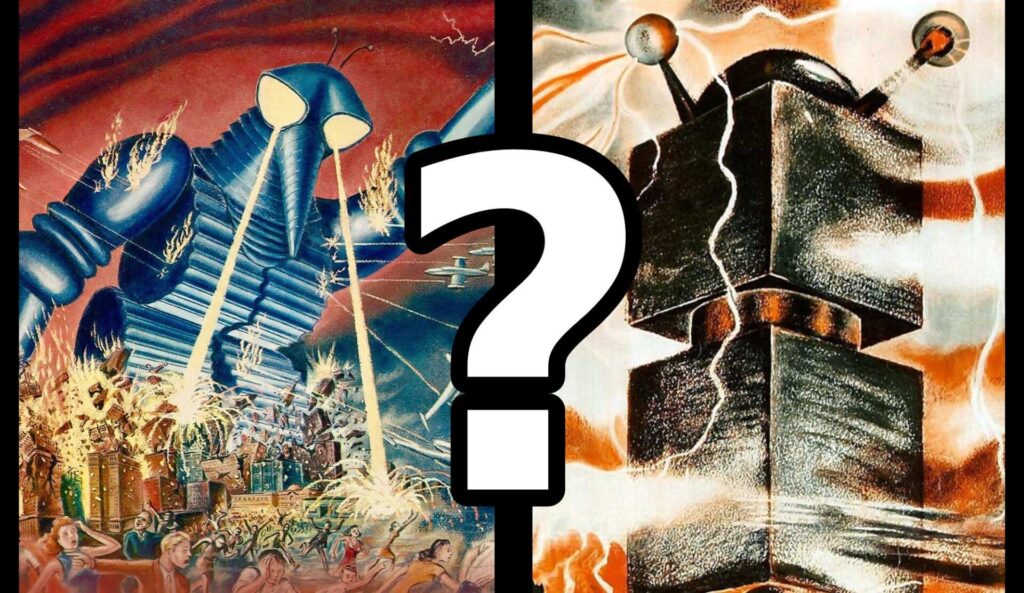

Giant robots are a familiar enough sight in movies these days. But who got their first? Two sci-fi films from 1957 have a potential title claim…
Google AI may be killing traffic to websites and transforming how users interact with the internet, but its ability to accurately answer questions is sometimes about as reliable as a slightly inebriated stranger in a pub.
Take the question in the headline of this article: what was the first giant robot in cinema? According to Google’s AI-generated result, which appears at the top of the page and crowds out all other links, the answer is the 1957 Japanese film, The Mysterians.
It sounds plausible enough. Hailing from Japan’s Toho Studios, it was another collaboration between director Ishiro Honda and effects genius Eiji Tsuburaya – creators of the iconic Godzilla (1954) and Rodan (1956). Given that Honda and Tsuburaya specialised in giant creatures capable of laying waste to entire cities, it makes sense that they’d be among the first filmmakers to come up with a massive, destructive robot.
But wait! The Mysterians was released in Japan on the 28th December 1957. A leaf through sci-fi cinema history reveals that director Kurt Neumann’s Kronos, which also features a massive metal death machine, made its debut in US cinemas in April 1957. (The Mysterians didn’t appear in North American theatres until May 1959.)
Starring the reliably stoic Jeff Morrow (This Island Earth, The Giant Claw), Kronos sees a flying saucer descend from space to take over feeble human minds with some sort of hypnotic energy ray. Eventually, the invader takes control of research scientist Dr Eliot (John Emery) who looks like a sinister Walt Disney.
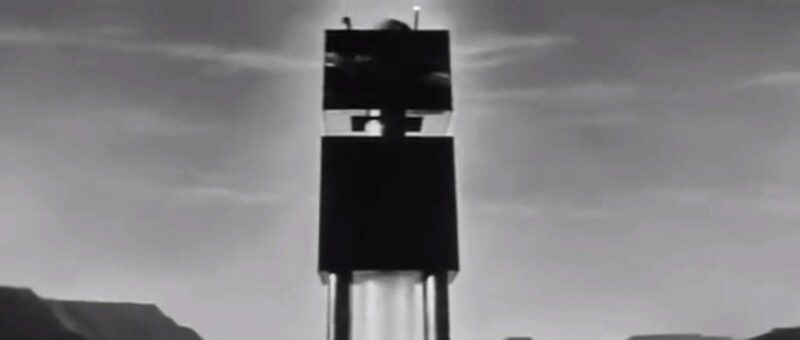
Eventually, a huge, cuboid machine emerges somewhere in New Mexico, where it immediately begins to drain the energy from nearby power stations. And the more energy it sucks up, the bigger Kronos becomes – until eventually it’s a skyscraper-sized colossus that stomps around on four piston-like legs.
Kronos isn’t, however, entirely autonomous – it’s essentially a remote-controlled drone, guided by the Disney-esque Dr Eliot (who in turn is controlled by the aliens – do keep up at the back). Still, a robot doesn’t have to be artificially intelligent to be classed as a robot, and there do appear to be times when Kronos continues its rampage even without Dr Eliot guiding it.
Read more: A few of cinema’s more unexpected and strange robots
Anyway, the military discovers that its weapons are useless against the alien machine, but then Morrow’s Dr Gaskell discovers a more scientific way of destroying Kronos before it steals all of Earth’s energy.
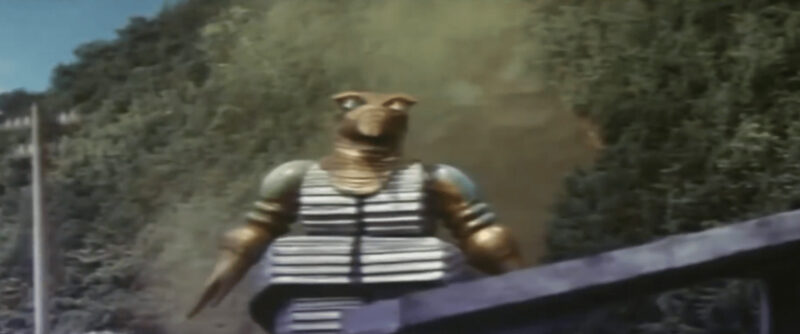
The giant mecha in The Mysterians is also of alien origin, but more recognisably a humanoid robot than the sleekly minimalist Kronos. Called Moguera, it measures some 50 metres high, has an armoured body that looks as though it was fashioned from tank tracks, and has a pointed snout that resembles a drillbit. It’s capable of crashing dramatically through mountains and bridges, and can set vehicles on fire with blasts of blue energy. (The robot’s arrival is also joined by a warbling electronic sound that sounds like a garbled radio signal.)
Moguera is the product of the dastardly Mysterians – an invading force that demands its own tract of Japanese soil and unfettered access to the country’s womenfolk. Naturally, the Japanese government doesn’t take too kindly to all this, and assembles a global coalition of high-tech weapons to defeat the aggressors.
The Mysterians had a much higher budget than Kronos: the former was made for roughly $160,000, while the latter was about $555,000 (going by the Japanese yen to US dollar exchange rate in 1957). It certainly shows: The Mysterians was shot in glorious colour, and features far more extensive sequences of destruction, as devised by Tsubaraya. Kronos contains a few decent effects shots of its own – including a quite cool glimpse of the liquid-like alien force leaving Dr Eliot’s body – but also leans heavily on stock footage.
Your opinion may vary as to which robot is better-looking. Moguera is the more charming of the two, and certainly more mobile – it can use its pointy snout to drill underground. (Its resemblance to a mole is no accident; it was originally conceived as a flesh-and-blood kaiju before the filmmakers decided to make it a mechanical threat instead.)
But Kronos, in all its boxy simplicity, has its own appeal – towering and jet black, there’s something quite eerie about its understated design. Maybe it was made by the same aliens that produced the monolith in 2001: A Space Odyssey.
What’s indisputible, though, is that 1957 is the year that the giant robot was born in cinemas. Slap bang in the middle of an era of colossal atomic monsters, with The Beast From 20,000 Fathoms (1953) emerging in the west and Godzilla (1954) stomping out of the far east, it was probably inevitable that someone would start thinking about a menace crafted from metal – particularly as George Pal’s adaptation of The War Of The Worlds revived HG Wells’ idea of alien death machines from the Victorian era. (The Martians’ manta ray-like craft were supposed to have tripodal legs, as in the book; they were made largely ‘invisible’ to save on animation costs.)
As Japan rebuilt in the post-war era, meanwhile, the notion of technology as both saviour and destroyer was clearly at the back of its storytellers’ minds.
In the world of manga, writer-illustrator Mitsuteru Yokoyama created Tetsujin 28-go, first published in 1956 – one year before Kronos and The Mysterians. About a 10 year-old boy who takes control of a gigantic, humanoid war machine (the titular Tetsujin 28), it was wildly popular, spawning animated TV adaptations, a live-action movie and toys for years afterwards. Although the lesser-known Atomic Powered Android, created by Uno Kazumichi, came earlier in 1948, it was Tetsujin 28 that brought the concept of the human-piloted mecha to the Japanese masses.
From these post-war roots, the giant robot gradually took hold in popular culture, later bringing us the likes of Mechagodzilla, Gundam, Macross, Transformers, The Iron Giant, Pacific Rim and too many others to mention. Today, it’s difficult to imagine a pop cultural landscape without gargantuan robots striding across it. In cinema, at least, it was an odd-looking contraption named Kronos that got there first.