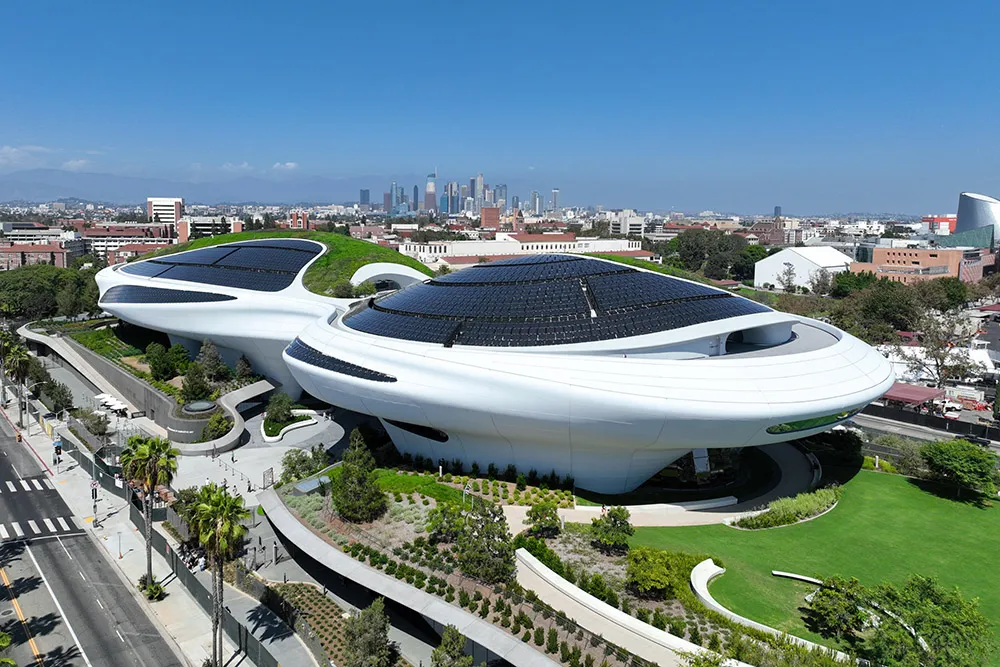

The new Lucas Museum of Narrative Art is a Rorschach test for the value of mass culture, the future of Los Angeles and the legacy of founder George Lucas. Its arrival also happens to highlight LACMA’s epic flop of a main new exhibition hall, the David Geffen Galleries building, which debuted across town four months ago.
LACMA’s failures, involving substantial public money, constitute serious lapses. Its director Michael Govan sits on the Lucas Museum’s board. Lucas’ wife, the prominent executive Mellody Hobson, who was a driving force on his project, is in turn a LACMA board member. Govan might prevail on Lucas to join as well, as an idiosyncratic and dyspeptic if public-minded voice. Perhaps Lucas could replace one of the seats still somehow held by the moguls Casey Wasserman and Steve Tisch, who of late have each had to relinquish ownership from their respective business enterprises following revelations of their connections to the sex trafficker Jeffrey Epstein.
LACMA spent a reported $724 million on its building. Geffen ponied up $150 million of that cost, conferring naming rights, while L.A. County taxpayers contributed $125 million and extended $300 million in credit. The rest came from private donors. For his part, Lucas put down a reported billion dollars for his own endeavor.
The projects merit comparison, aside from their opening dates and price tags. They both feature similarly sized gallery square footage, a shared curatorial radicalism, high civic expectations and key orientations within their historic neighborhoods — LACMA along Museum Row in the Miracle Mile, the Lucas Museum within Exposition Park.
To be clear, LACMA possesses one of the world’s great encyclopedic collections of artwork. The Lucas Museum has a cabinet of curiosities, the crown jewels of which are production pieces from Star Wars and other fortune-making IP that made this venture possible.
But Lucas has directed and produced a much better artgoing experience. Even if his show-over-tell instincts, including negligible wall text, means there’s far too little context for his creative choices.
Both fresh facilities, which feature circular arrays of interconnected galleries with no marked beginnings or endpoints, have gone all-in on a thematic approach to curation that devalues chronology and geography. The result at LACMA is an incoherent, chaotic ping-pong across art history, from Asian neolithic vessels to European modernist abstraction. Visitors don’t know where they are, where they’re going or why. It’s time-is-a-flat-circle as museological model.
The Lucas Museum, at least, demonstrates a basic commitment to, well, narrative, with a display exploring the world history of mythology. Elsewhere, its organizational groupings are simplified at times to silliness: “love,” “play,” “motherhood.” However, the spatial flow can lead to arresting connections and associations, as when pieces in the “Western stories” section, which depict gunslinging American cowboy figures from the 1800s, are in immediate view of similarly posed manga heroes in the next room, conjured by commercial illustrators working in postwar Japan.

People walk around the new David Geffen Galleries building at LACMA on April 15, 2026.
Frederic J. BROWN/AFP/Getty Images
At LACMA, the most glaring problem has been just that — the glare. Its Pritzker Prize-winning Swiss architect Peter Zumthor had never built anything at this scale, and never in relentless desert light. His concept of wraparound, floor-to-ceiling gallery windows is negligent, and the attempted remedy of instituting semi-transparent metallic curtains hasn’t fixed the issue. Throughout any given day, even when overcast, there are reflection challenges occluding parts of the collection. Meanwhile, the Lucas Museum building, orchestrated by a man who spent his film career calibrating light apertures, and designed by the attentive architect Ma Yansong, allows for similar expansive, elevated views across the city from dedicated alcoves while (sensibly!) retaining controlled light within the interior gallery spaces.
The other significant point of contrast is the facilities’ grounds. Zumthor’s sprawling building, raised 30 feet and comprised of 85,000 cubic yards of concrete spanning across Wilshire Blvd., shadows a comically bleak, vast hardscape expanse most comparable to a freeway underpass that’s especially unwelcoming for children and the elderly. It’s the stuff of the late L.A. urban theorist Mike Davis’ dystopic nightmares. Whereas at the Lucas Museum, the veteran local landscape designer Mia Lehrer has conducted a lesson in topographical storytelling with regional vegetation that draws on California’s varied terrain. It complements Ma’s cloudlike structure (which, unlike the Zumthor edifice, features extensive rooftop greenery) and is itself manifestly community spirited.
At some point, LACMA will need to address its messes. If the self-described “contrarian” Lucas, 82, is still around, it would be wise to consult him.