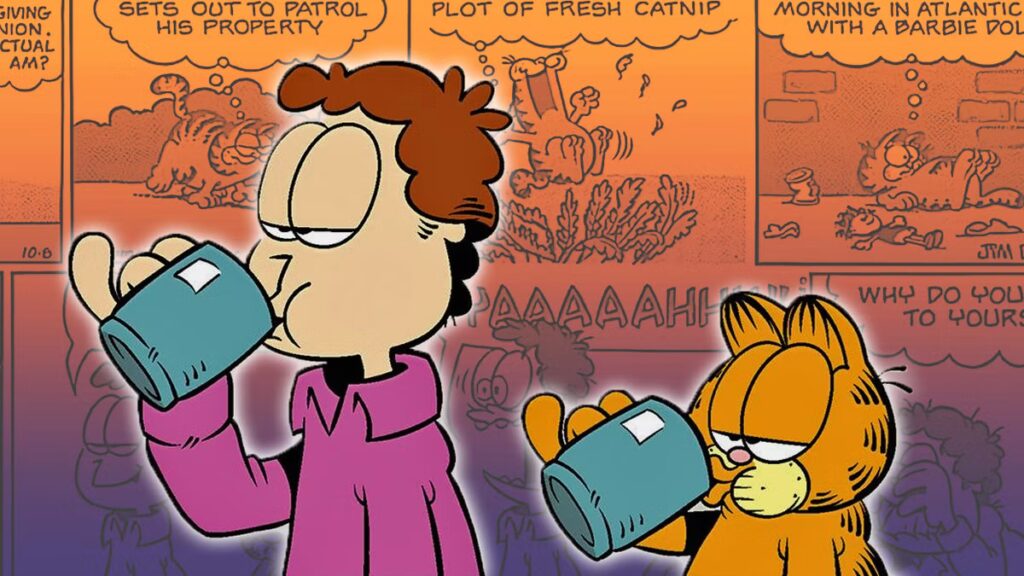

Garfield comics have continued to amuse readers for over thirty years. Enjoyed by adults and children alike, Garfield, his owner Jon, and the other unique characters introduced by Jim Davis along the way have found a special place in the hearts of millions. While most comics are accessible to any age group, numerous strips are best understood by adults. Garfield isn’t just remembered for hating Mondays and loving lasagna; he’s become a cultural icon that’s granted a new sense of importance for comic strips.
Much of Garfield’s humor stems from his personality and behavior. As Garfield possesses many adult qualities, it is no surprise that multiple comics in the series would be best understood and enjoyed by adults. Whether through diction, concept, or situational humor, Davis presents some of his funniest material in these adult-themed comic strips.
Publication Date: Oct. 31, 1986

Sometimes, the source of the adult aspect within a strip can be as simple as Davis’s diction. A single word can mean the difference between comprehension or lack thereof. This is the case when Jon finds Garfield lying around the house and mentions that apathy is a failing. Garfield is known for doing just that, and his response is hilarious, but only in the proper context.
The word “apathy” isn’t in the vocabulary of many children. As such, Jon’s comment and Garfield’s response might go over the heads of a younger audience. His reinforcement of Jon’s accusation of not caring through the statement of “so what” provides humor through irony. This irony can only be revealed if the term Jon employs is understood enough to sneak this entry into the rankings.
Jon’s New Coffee Has Too Much Caffeine
Publication Date: Jan. 25, 1989

One concept likely incomprehensible to most children involves the adult ritual of the morning cup of coffee. Many adults use the stimulation of caffeine found in coffee to help wake them up and start their day. Jon and Garfield are no different. While they both enjoy the first cup of the day, the experience is quite different when Jon purchases coffee with twice the caffeine.
Gee, a new coffee with twice the caffeine.
Humor ensues when Garfield notes the necessity of the provided miniature crowbar that Jon will need. The additional stimulation has Jon’s eyes wide, and his fingers latched to his cup. Anyone who has partaken can relate to the feelings and bodily reactions that come with too much caffeine. The joke presented by Davis once again only lands if the reader understands the concept in question.
Garfield Worries About the Ingredients in His Cat Food
Publication Date: May 15, 1979

Many adults are concerned about the ingredients in their food. While a child might not think twice about what they eat beyond aesthetics, numerous adults concern themselves with unhealthy ingredients in their meals. Garfield has also displayed this concern. While he enjoys mealtime, even Garfield understands the possible consequences of eating foods with too many questionable additives.
The humor in the strip stems partly from Garfield’s reaction to reading the enormous list of ingredients in his cat food box. The other comedic element is that Garfield understands the situation better than Jon. While Jon might not perceive the possible consequences of feeding his cat this food, Garfield certainly does. Combining concepts and Jon’s ignorance leads to comedy that is best understood by adults.
Garfield Hides His Indifference Through Detachment
Publication Date: June 25, 1998

Other concepts not typically grasped by youth people include indifference and detachment. Both concepts are touched on when Jon excitedly exclaims to Garfield that the time has come to change the refrigerator light. The diction employed by Davis in Garfield’s response provides amusement. However, the humor can only be properly understood if the reader comprehends each word in the concluding statement.
Garfield’s comment reveals his lack of enthusiasm concerning trivial matters if understood. The statement also implies that Jon cares too much about such things, and his enthusiasm should be regarded as highly exaggerated. An adult who comprehends these terms and concepts immediately understands what Garfield means, and that Jon must not have a social life. A child, however, might struggle with these ideas.
Garfield Solves a Dilemma Presented in “Hamlet”
Publication Date: Sep. 4, 1987

An activity Garfield enjoys regularly is watching television. During a showing of “Hamlet,” he turns the set off directly after the famous line, “to be or not to be.” When Jon asks why he turned the television off, his response reveals a line of reasoning typically found only in adults. According to Garfield, he has solved the problem presented with “modern technology.”
The terminology used by Garfield isn’t the only element difficult for a child to understand. The concept he presents can also pose a challenge. By turning off the television, Garfield reasons he has answered the question appropriately. If the material is not being viewed, the answer must now entail “not to be.” Once again, Davis’s diction and ideas present a humor best understood by adults.
Jon Decides to Reflect on His Day
Publication Date: Jan. 10, 2001

Sometimes, the lack of comprehension concerning an event can stem from a lack of experience. This is the case when Jon reflects on his day with negative results. A child would likely not have the experience necessary to understand why Jon might have such a tormented response to daily reflection or why Garfield knows Jon had a terrible idea. The understanding required comes from experiencing many days that ended badly in one form or another.
Why do you do that to yourself?
Jon’s behavior poses multiple possibilities behind his reaction. He might realize that he feels unfulfilled concerning the day’s events. Maybe he thinks he didn’t accomplish enough. Jon might even feel like his life is devoid of purpose. Either way, having relatable experiences is necessary for comprehending the material. The combination of subtlety and multiple possibilities behind Jon’s behavior lands this entry in the middle of the pack.
Garfield Admits He Has Been to Jail
Publication Date: Feb. 10, 1999

Another concept best understood by adults is the idea of going to jail. While they might comprehend a certain amount of punishment for bad behavior, time in jail is quite unlikely for children. On the other hand, adults understand all too well the possibility of spending time incarcerated for criminal activity. Garfield is no exception, as he admits to Jon when called out for his negative behavior.
By relating that the food isn’t as bad as most believe, he reveals he has spent time behind bars. Jon’s reaction tells the reader he might not be surprised to find out his cat has a criminal record. The personification is particularly effective because, while Garfield commonly exhibits human qualities, in this instance, he discusses specific events normally experienced only by people with a relatable indifference.
Garfield Finds Some Wild Catnip and Has an Adventure
Publication Date: June 12, 1980

One occurrence not experienced during childhood is the act of over-enjoying mind-altering substances to the point of waking the next day in a different location with no recollection of the previous evening’s events. This happens to Garfield when he stumbles across wild catnip. After an excited frolicking, he awakens in a filthy part of another town with no memory of what happened the day before.
The setup is perfect because the last portrayed memory before awakening is Garfield enjoying the catnip. Events in between are left to the imagination. The art of the final frame reinforces the idea that Garfield made a mistake. Using brick, concrete, and litter symbolizes dangerous urban areas with high crime rates. While beyond a child’s grasp, the strip proves humorous for adults.
Garfield Gets a Talking Toy That Might Be Smarter Than Him
Publication Date: Oct. 8, 1982

The matter of insulting the intelligence of another might be experienced by the young, but it is best understood at its deepest level by adults. An additional level of depth in the act is exhibited by Jon when he gives Garfield a talking toy cat. Garfield assumes the toy is silly and meant to insult his intelligence. Upon pulling the string, he discovers he might have been wrong and that the toy could surpass his intellect.
A child would face multiple challenges attempting to comprehend the humor presented. The initial layer of the toy’s intelligence might be obvious, but the setup, meaning behind the toy’s statement, and the sarcastic nature of Garfield’s response would likely be incomprehensible to a younger reader. On the other hand, an adult with a comprehension of the devices employed and deeper levels of the joke would easily see the humor.
Garfield Finds Pleasure in a Depressing Environment
Publication Date: Sep. 24, 1984

The pleasure derived from a desire to be sad and purposefully seeking out depressants is an important concept beyond the reach of most children. As such, the humor in Garfield’s predicament is best understood by adults. The items listed, from the cold, rainy day to the radio playing blues, culminate in a singular theme surrounding Garfield’s situation. Sometimes, feeling down can yield positive results.
While this concept is beyond a typical young mind, most adults understand the positive aspects of intentionally seeking out a “blue” environment. Reflecting in such a way can bring a greater comprehension of events and new perspectives. In this case, Garfield’s final statement provides both comedy and relatability. The use of a complex concept, irony, and the subversion of expectations place this entry at the top of the list.
- First Film
-
Garfield: The Movie
- First TV Show
-
Garfield and Friends
- Latest TV Show
-
Garfield Originals
Premiering in Jim Davis’ comic series, the Garfield franchise follows the adventures of Garfield the cat, Odie the dog, and Jon the human.