
Across the course of his many lifetimes, the Doctor has faced countless foes, including the Cybermen, the Ice Warriors, and his old schoolmate and frenemy, the Master. Every Whovian has their favorites. Each has tested him, his companions, and even the fate of the universe.
However, in 1988, in the waning era before Doctor Who left TV screens for 16 years, a series of episodes had the Doctor fight his greatest enemy for the very last time. Well, before showrunner Russell T. Davies brought them back in the sixth episode of the revival, “Dalek.”
The Daleks’ farewell in Classic Who remains iconic
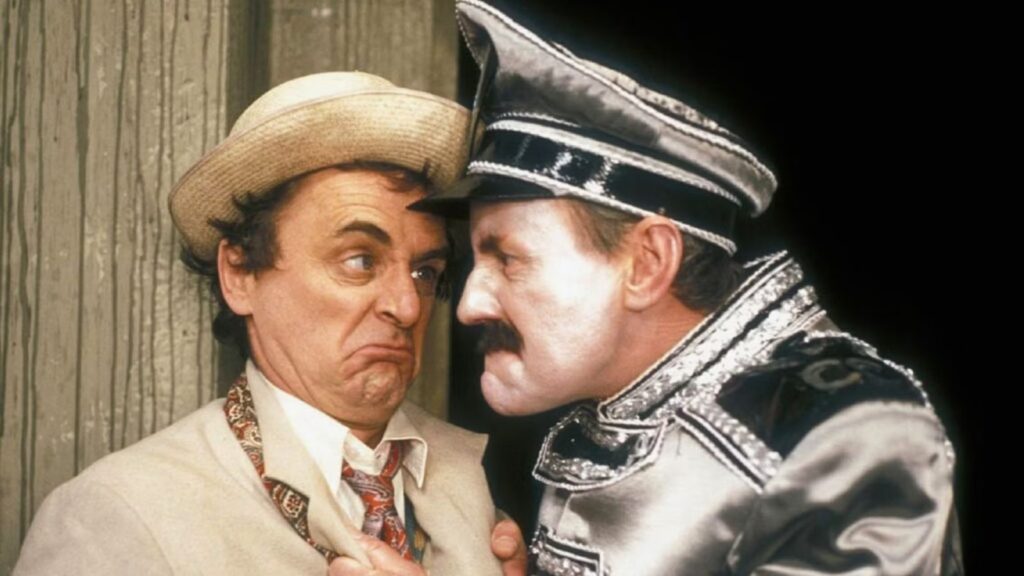
“Remembrance of the Daleks” is a four-part arc that follows the Seventh Doctor (Sylvester McCoy) and his companion Ace (Sophie Aldred) as they travel back to London’s Shoreditch in 1963. Whovians will remember that the First Doctor (William Hartnell) spent much of that year on Earth, primarily so his granddaughter, Susan (Carol Ann Ford), could attend Coal Hill School (fun fact: it’s the same school where the Twelfth Doctor pretends to be a caretaker). However, in “Remembrance of the Daleks,” writer Ben Aaronovitch dropped a bombshell: before he absconded from Earth to go on an adventure, the Doctor left behind a powerful object capable of triggering stars to go supernova: the Hand of Omega.
Several seasons and Doctors later, the Doctor returns to Earth with a new face and a new companion, only to discover that two Dalek factions are after the Hand of Omega. They join forces with Captain Gilmore (Simon Williams) and Sergeant Mike Smith (Dursley McLinden), who look to rid Earth of the Dalek threat.

Most Classic Who fans fondly remember “Remembrance of the Daleks.” It’s easy to see why: this is one of the best arcs featuring Seven and Ace. It puts McCoy’s feet to the fire as he portrays a more manipulative Doctor trying to trick the Daleks, and he is perfectly matched by Aldred’s rebellious, tough attitude as Ace.
Yet as much as McCoy and Aldred deliver phenomenal performances in this arc, the Daleks ultimately steal the show. Whenever these dome-shaped monsters appear, it’s to mess with the Doctor and/or the human race. This time, though, the only enemy these two Dalek factions see is each other — a conflict rooted in real-life prejudices that Aaronovitch explores with clever, sophisticated writing across this four-episode arc.

It’s well known among Whovians that the Daleks’ creator, writer Terry Nation, conceived of them as allegories for the Nazis and the Nazi Party. That allegory is clear from their introduction in 1963’s “The Daleks,” where these bug-eyed villains quickly establish their belief that they are the purest race and that everyone else must be exterminated as they wage war against another alien species, the Thals.
In “Remembrance of the Daleks,” this xenophobic, racist viewpoint comes to a head when the Doctor discovers that the Daleks vying for the Hand of Omega are at loggerheads with one another. The first faction is the Imperial Daleks, upgraded Daleks modified by Davros (disguised as the Emperor). The second faction is considered the renegade faction and isn’t as shiny and new as its Imperial counterparts, presumably because they didn’t undergo the same kind of modification. After all, the Daleks were designed to be ‘racially pure’ from the beginning, so any modification muddies those waters.
Doctor Who has never been shy about linking the Daleks to Nazism, but Aaronovitch goes a step further in “Remembrance of the Daleks” by giving the renegade Daleks human allies: a fascist group led by Ratcliffe (George Sewell). While it’s not hard at all to see that Ratcliffe is a despicable human being from the get-go based on how overtly racist he is, Aaronovitch manages to shock audiences with the reveal that Sergeant Mike Smith, who warmed audiences up to him by being charismatic, is in fact a traitor — and a racist to boot. What made this reveal so alarming was that Smith had portrayed himself as kind and intelligent, a sharp contrast to the overtly ignorant Ratcliffe. Yet, as Aaronovitch’s writing made abundantly clear, you cannot always tell a monster simply by looking at them.

With Earth caught between these two extreme factions, the Doctor has no choice but to get involved. Since each group of Daleks sees the other as an abomination, the Time Lord can easily exploit their hatred, leading to an explosive finale where, with the renegade Daleks destroyed, the Doctor is able to trick Davros and the rest of the Imperial Daleks into blowing themselves up — and destroying their homeworld, Skaro.
It would be the last time Whovians saw Daleks in Classic Who, but Aaronovitch’s desire to write a complex story rooted in its era gave them a memorable send-off and a poignant reminder of why the Daleks are considered the Doctor’s most monstrous enemies.