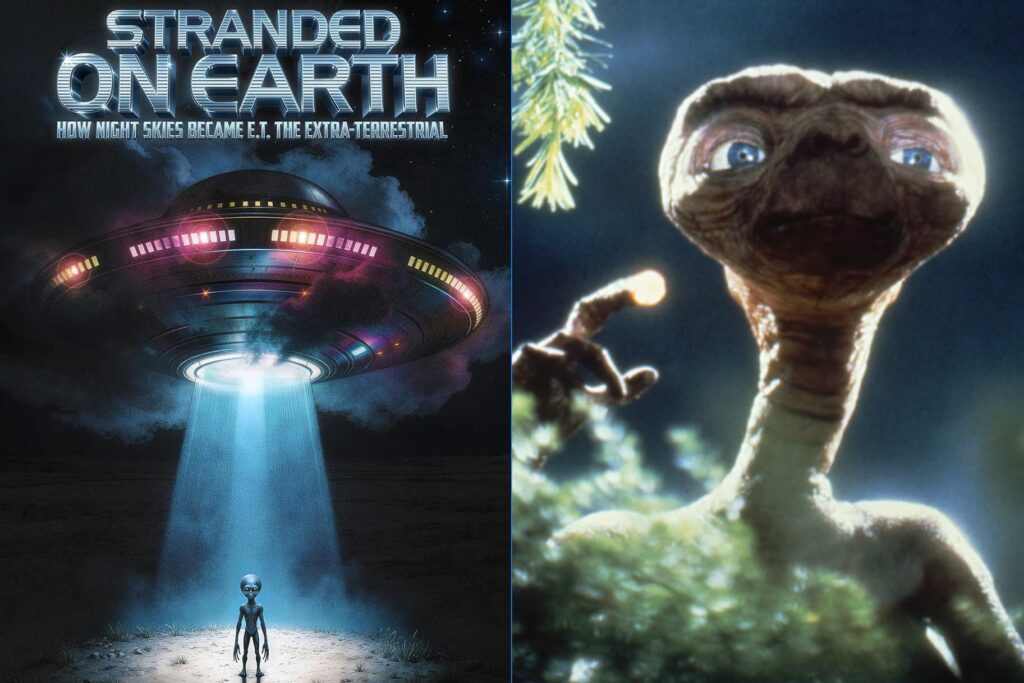

The origin of Steven Spielberg’s E.T. the Extra-Terrestrial is wilder than you could ever imagine.
Before taking the family-friendly form that captivated moviegoing audiences back in 1982, the seminal sci-fi project started off as a darker follow-up to Close Encounters of the Third Kind entitled Night Skies. That unmade film has gained a mythical status among cinephiles through the decades, but no one has ever pieced together the full story of its inception and evolution until now.
Max Evry’s Stranded on Earth: How Night Skies Became E.T. the Extra-Terrestrial (now available for pre-order) dives headfirst down the rabbit hole, and doesn’t look back.
The upcoming book from 1984 Publishing features brand-new interviews with a plethora of primary sources (except for Spielberg) who were present for the development of both pictures, and ultimately serves as a fascinating and thoroughly exhaustive exploration into one of the greatest what-if stories to ever come out of Hollywood. Warts and all!
New Book Explores How E.T. Started Off as Sci-Fi Horror Movie Night Skies
“I’ve always been fascinated with Night Skies because I have a more cynical, dark nature to what I’m interested in when it comes to the genre,” Evry exclusively told SYFY Wire over Zoom. “The idea that there was this other side of the coin to E.T., one of the most sentimental blockbusters ever made, always intrigued me. There’s the company line about E.T., which is this magical film made to touch the hearts of everyone, and there’s the nitty-gritty, business-y truth, which is more what my book is.”
His ultimate goal was to give the reader enough information, “so they can picture it in their minds” by the time they’ve finished reading the book. “I feel like whoever’s reading this book is gonna leave feeling like they’ve seen Night Skies.”
He continued: “I do want to emphasize for people who maybe don’t give a s–t about Night Skies, or don’t know what it is, the book is still very much about E.T. We focus on E.T. for several chapters, with the stars and a lot of people who made it. Many people who were involved in Night Skies then came over to E.T.“
It all begins in 1955 with the Kelly–Hopkinsville encounter, when a farmhouse in rural Kentucky was supposedly terrorized by nasty, mischievous visitors from outer space. Like the Roswell incident the previous decade, the event represents a watershed moment in the development of UFO lore.
“Whether you believe it or not, the cultural impact that story had was seismic,” Evry said of Kelly–Hopkinsville, which was investigated by the Air Force-sanctioned Project Blue Book. “That’s where we get the term ‘Little Green Men.’ That’s where we get this idea of aliens being less than benign. It really branded what an Experiencer situation is for a lot of people.”
That was the jumping-off point for Night Skies, with Spielberg agreeing to produce the title for Columbia Pictures.
John Sayles (Return of the Secaucus 7) wrote the script, while Ron Cobb (Conan the Barbarian) and Rick Baker (An American Werewolf in London) were chosen to direct and develop the practical alien effects, respectively.
Where Close Encounters provided a warm and fuzzy depiction of alien contact, however, Night Skies would do the exact opposite.
“We have Spielberg’s notes on the script,” Evry added. “He was pushing John to go further. He was saying, ‘Let’s really scare the hell out of people with this thing!’ He clearly had these darker instincts.”
Development got pretty far along, with a good deal of money spent on Baker’s animatronics, before Spielberg conceived E.T. on the set of Raiders of the Lost Ark alongside screenwriter Melissa Mathison. The pair essentially married the ending of Night Skies, where a benevolent alien gets left behind on Earth, with a truly gonzo contribution from future Back to the Future creators Robert Zemeckis and Bob Gale. You’ll just have to read the book to learn more about the latter.
The sudden change made a lot of sense financially. As Evry put it, “I love how much of E.T. was born out of just being a cheapskate. Like, ‘We don’t want to pay for five aliens. We just want one.'”
At the same time, the pivot from Night Skies to E.T. “is sort of foundational to who Spielberg is,” said the author, “which is to take something dark and turn it into something light, something positive. Some people criticize him for that, but I think that is part of his brilliance and part what makes him an artist. That’s his point-of-view. It’s a populist point of view, but it’s it is a point-of-view.”
Indeed, Steven Spielberg has gone on record (via Mick Garris) that he has “some ideas that would make Cronenberg shudder, but I can’t make them because of who I am right now.”
“If the most powerful filmmaker who ever lived feels trapped, what do you say about that?” mused Evry. “I guess the theme of the book is about that. It’s about that instinct to pivot. That instinct to, as he says, to rescue. The instinct to make things whole at the end. If you want to psychoanalyze it, you can say, ‘Oh, well, it came from his childhood and the divorce and wanting to make his family whole again.’ For whatever reason, that’s his instinct.”
Still, no one could have guessed just how monumental a hit E.T. would be. Given that Spielberg went over budget on Jaws, Close Encounters and the disastrous 1941, Columbia boss Frank Price agreed to let Universal to take over the project (“one of the biggest blunders in Hollywood history,” wrote The New York Times in his 2025 obituary).
Even then, Universal had reservations.
“They didn’t really want to make E.T.,” stressed Evry. “They were doing it as a way to curry favor with him, but they weren’t enthusiastic about it. It started the summer as the lowest-tracking movie of the summer of ’82 and was originally only going to open in like 500 theaters. They had almost no marketing planned for it. Then they started previewing it, and it’s like, ‘Oh my God! What do we have here?!’”
The book, he noted, “gives you a glimpse into the last time people in Hollywood ever doubted Spielberg. It’s like, ‘Could he make a small movie? Could he make something economical on time and on budget without going crazy? And would anybody want to see this beyond little children?’ I love the Rocky/underdog nature of the triumph of E.T. We only think of it as a success, [but] there was a time when people were like, ‘I don’t know, man. This seems weird.'”
No part of Night Skies went to waste as Spielberg used almost every part of the proverbial animal on subsequent productions like Poltergeist and Gremlins.
“What my book does that nobody else has done before is actually go to great lengths to say, ‘Okay, how specifically?'” Evry said. “What are the points of comparison here? How did this movie actually influence that movie? And we and we break a lot of the myths about it.”
Stranded on Earth also argues the case that Carlo Rambaldi did not create his Oscar-winning E.T. puppet “out of whole cloth,” but was very much inspired by Baker’s initial Night Skies work.
“It’s a tough situation,” admitted Evry, “but we’re almost 45 years removed from this, and I think we can talk about it. My book cannot hurt E.T. at this point. I can’t take away Rambaldi’s Oscar. It’s done.”
While Spielberg declined to be interviewed for Stranded on Earth, Evry trawled through a number of archival interviews, where the celebrated director spoke openly about his sinister vision of alien visitation.
“To a certain extent, he’s kind of whitewashed the history over the years to kind of exclude Night Skies when he talks about E.T.,” the author explained. “Whereas, if you go back, he’s much more open about the fact that this is where it started…To be clear, I would love to talk to Spielberg. If he reads the book and likes it, we’ll happily do another edition.”
Stranded on Earth: How Night Skies Became E.T. the Extra-Terrestrial is on sale from 1984 Publishing Oct. 27.