
When I broke up with my ex four-plus years ago, I had criteria in mind for the type of person I wanted to date next. Most of it I couldn’t put into words. Handsome but not obnoxiously so? Has a fulfilling life without me but will make room for me within it? But there was one quality I could and did articulate: I wanted to be with someone who reads novels.
This ex certainly knows how to read — he’s pursuing a Ph.D.! — but he did not help me satisfy a childhood fantasy probably gleaned from Tumblr bloggers and Gilmore Girls, of reading a classic from over a boy’s sweatered shoulder in the window seat of a wood-paneled library. The desire was both literal and symbolic. It sounded really fun and felt like a good sign, like we would probably share other values if that base was covered. I’m a reader at my core, a girl who consumed some 100 chapter books about having a first kiss before coming anywhere close to the real thing.
The creators of a splashy new dating app are betting on the power of the reader identity. Readme, “a dating app for people who read,” is engineered by the team behind Co–Star, the social astrology app that I’ve heard, anecdotally, has played a role in determining the compatibility of more than a few situationships. A friend has taken to calling it, in its first weeks available only on iOS, the “Gen Z OkCupid for nerds who got hot.”
With familiar features like a photo carousel, quick biographic stats, and tapping left for no and right for yes, Readme isn’t reinventing the infrastructure of online dating (nor is it even the first dating app aimed at readers). But the hope, as Head of Brand Emily Segal tells me, is that an aligned taste in literature can efficiently “signal that someone might be your kind of person.”
“It feels kind of pretentious to be like, ‘I will only date people that read,’” says Madi, 28, who is looking for a long-term relationship with a woman in New York. “I wouldn’t consider it a deal-breaker or something that I really look for. But I think it signals an interest in learning, and self-improvement, and fighting against the ways that the digital world is trying to pull us in constantly.” For profiles, Readme prompts users to choose one featured book as a conversation starter. Madi chose Atmosphere by Taylor Jenkins Reid. “I went to my Goodreads and was scrolling through books I’ve read recently,” she shrugs. “I was trying to find one that didn’t seem cliché, was well-known enough, but would also seem niche.”
To get started, a time-intensive but supposedly fun personality quiz asks users to select from among an array of choices for communication styles and political beliefs, and to choose between different literary passages based on gut feeling. J.R.R. Tolkien or Georges Perec? Roberto Bolaño or Kazuo Ishiguro? Segal says it’s inspired by Jacques Lacan’s methods of analysis of the subconscious. To me, the selected excerpts feel pretty arbitrary, to the point that I wondered if the passage pairings were chosen by AI. (Co–Star uses a mix of AI and human writers and was acquired earlier this year by AI company Midjourney. Readme confirmed the use of AI to categorize the literary source material and to write code, but no user-facing copy.)
Readme intentionally sorts people into types, according to three main axes: how you relate to your desire, how you communicate your desire, and how you make sense of your desire. Your responses to the quiz translate into archetypes with names like Angel of History, the Campaign Against the Middle Ground, the Universal Valentine, and Resident Artist of the Undertow. (I am mildly insulted by my designation of Former Gifted Child, especially considering I did not test into my school district’s gifted program at age 6.) The archetypes are meant to provide context and a “sense of the vibe” when you match with someone, but the app doesn’t filter anyone out based on it.
“Dating within the writing scene has less to do with you both being writers than each of your individual DSM-5 diagnoses that you bring to the relationship.”
“What it actually generated, I have never felt so accurately read,” says Ripley Soprano, writer, organizer, and publisher of Dirty Magazine, whose archetype is the Biggest Fan of Reality. “It’s all about my relationship to stoicism emotionally, and how that relates to prose that I might engage with … The ways to tag yourself or identify yourself on the app seem to encourage people not to just spend tons of time in the app, chatting back and forth with no real plan to meet up, but to directly push you to meet someone at a bookstore or whatever. Whatever happened to the bookstore meet-cute?”
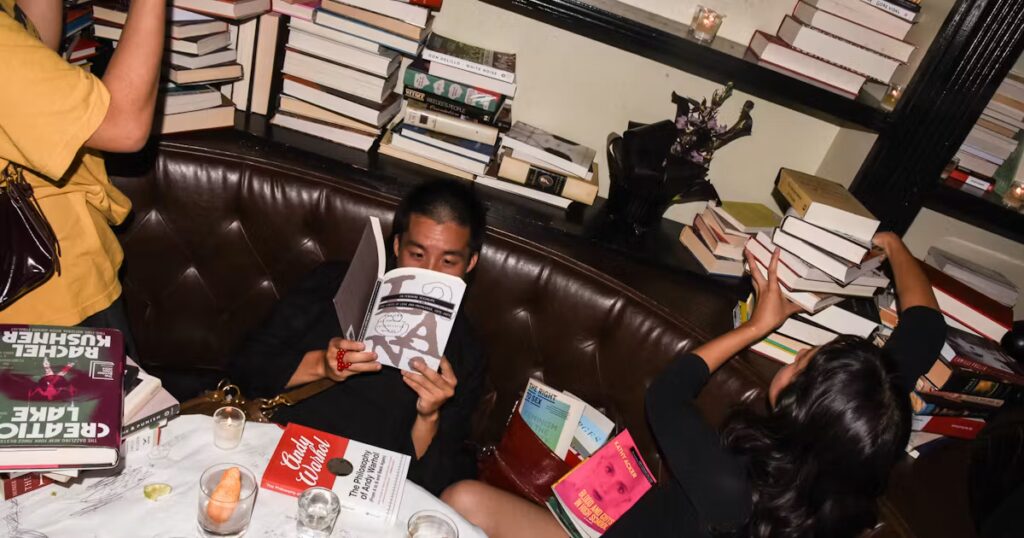
Readme debuted with a very New York launch, where real bodies jostled for real martinis in a real bar. The mid–Fashion Week event catered to a specific demographic: the intersection of people who publish and party, among them the beautiful editors of literary magazines, poets dubbed members of the “downtown literati” by Substack scene reporters, and Readme Creative Director Caroline Calloway. A large chunk was neither single nor ready to mingle. I attended with my boyfriend (whom I met through mutual friends and who indeed reads many novels!), as did novelist Stephanie Wambugu. Comedian Adam Friedland was there, weeks out from his wedding. Writers Isle McElroy and Leah Rae Hulgin took advantage of the free photo booth for their own coupled purposes. “I tried to only invite straight boys,” cohost and Happy Hour author Marlowe Granados says, which helps explain the guy imploring the beleaguered Funny Bar doorman to let him in because “I’m Marlowe’s ex-boyfriend!”
“I think dating within the writing scene has less to do with you both being writers than each of your individual DSM-5 diagnoses that you bring to the relationship,” says Ben Fama, a writer and the editor of small press Wonder, who has made a Readme profile. “So if you meet someone at a literary event, that could really go any number of directions.” Fama is clear that meeting someone IRL at one of these events is more than possible; there are several opportunities every week. (The next Poetry Is Famous reading, which Fama cohosts, is Oct. 1 in Ridgewood, Queens.) Soprano thinks the only way any kind of shiny new digital phenom can last is by cultivating a connection to physical media and catering to people beyond the screen and in real life. When Madi and I speak, she has a speed dating event in her calendar for the following week.
Segal dismisses the existing dating apps on the market as transactional and performative — an interesting descriptor given the panic about performative male readers, aka men who might pose with their nose in a copy of the latest Harper’s solely to attract women tired of tapping through a sea of shirtless hiking photos and indiscernible groomsmen group shots. The app, though, is certainly the latest in a lineage of connection formed through consumption habits. Does having the same Letterboxd “top four” as someone mean you’re destined to be together, or just that you come from similar backgrounds and were exposed to similar things? Readme “creates a portrait of your taste in language,” Segal says — so Lacanian. “We think that can show you something about a person’s interior life without explaining everything about them.”
Lurking on the app, I came across the profile of a 21-year-old bi-curious Dallas resident who makes multiple references to writer Vivian Gornick, whose work I love. They are also a Former Gifted Child, and we are apparently 87% similar. I feel overwhelmed by how many smart, cool, interesting people there are in this world, and how many matches there are for them — in the most romantic, pre-product-absorption sense of the word. No, you won’t communicate well with all of them, or live nearby, or find them physically attractive, or be available at the same time. But isn’t it comforting that they exist?
Maybe my intention in asking the universe to give me a boyfriend who reads was to feel again that intoxicating curiosity about another person’s interior life. You get that from falling in love. You also get it from a good book.