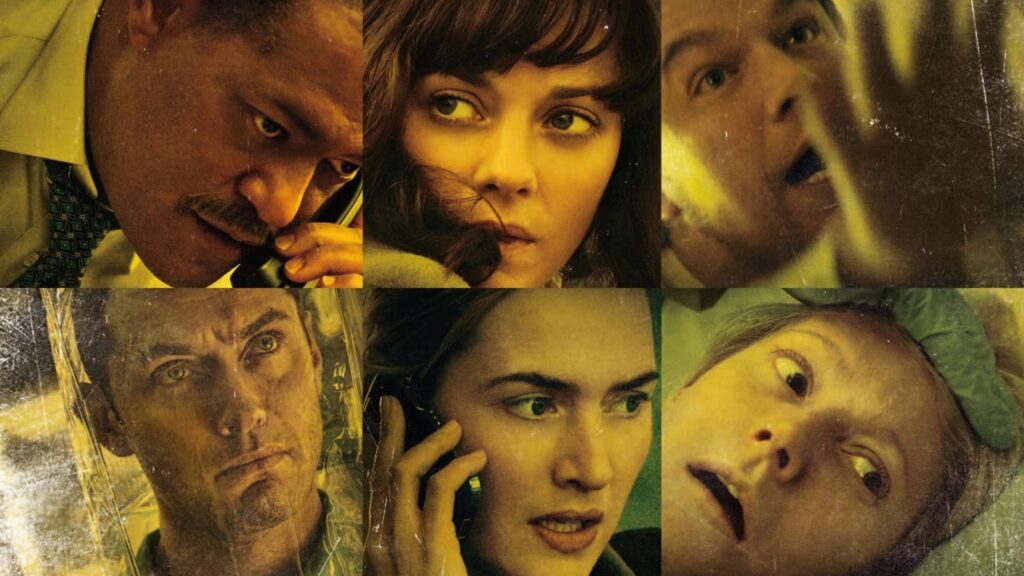

Hasitha Fernando looks at the story behind Steven Soderbergh’s pandemic thriller Contagion…
Over the years Hollywood has churned out a host of pandemic thrillers that range from downright outlandish to the eerily prophetic. Contagion cheerfully belongs to the latter camp, where the devastating impact of an unfolding global pandemic was portrayed in chillingly accurate fashion. As the effort celebrates its 15th anniversary, we take a look at its behind-the-scenes story and what went on during the making of the film.
The filmmakers wanted to make it as scientifically accurate as possible
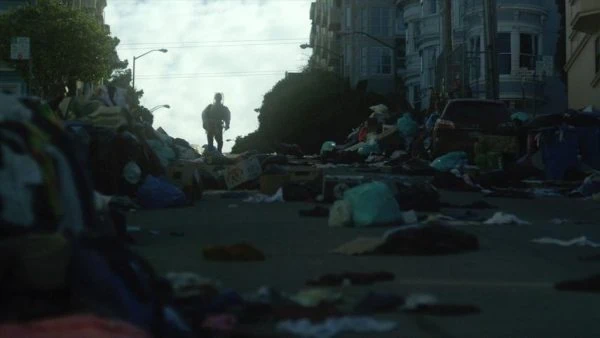
After the completion of The Informant! in 2009, Steven Soderbergh and writer Scott Z. Burns were pondering what they should tackle as their next project. The pair had previously planned to create a biographical film on Leni Riefenstahl, a trailblazing filmmaker during the 1930s Germany and during the rise of the Nazi party. However, Soderbergh soon realized that it wouldn’t be a feasible choice as a film centering on the Riefenstahl wouldn’t attract much of an audience. It was at this juncture that Burns, intrigued by the whole concept of diseases transmission, decided that making a movie regarding a disease pandemic that would play out as a medical thriller should be what they ought to do next. In order to achieve a greater degree of realism, Burns consulted Larry Brilliant, renowned for his work in eradicating Small Pox, and W. Ian Lipkin, a leading epidemiologist and along with the inputs of WHO representatives, Burns was able to glean the plot points needed for crafting the script. The screenwriter even met with Laurie Garrett, the author of Coming Plague, to discuss other potential details required to tweak his script.
The 2009 Swine Flu Pandemic helped to further refine the script they were doing

Although Burns had done his fair share of research about the global pandemics that had taken place up to that point, the 2009 flu pandemic truly impacted his understanding regarding the psycho-social dynamics that play out at the onset of a worldwide pandemic. And it was the people’s response to the sudden changes implemented by governments that truly intrigued him, “I saw them come to life”, Burns revealed, “and I saw issues about, ‘Well, do you close the schools and if you close the schools, then who stays home with the kids? And will everyone keep their kids at home?’” All these myriad ways in which different individuals and people as a whole reacted to this unprecedented situation helped Burns to fine-tune the script further.
Steven Soderbergh served as the film’s cinematographer as well
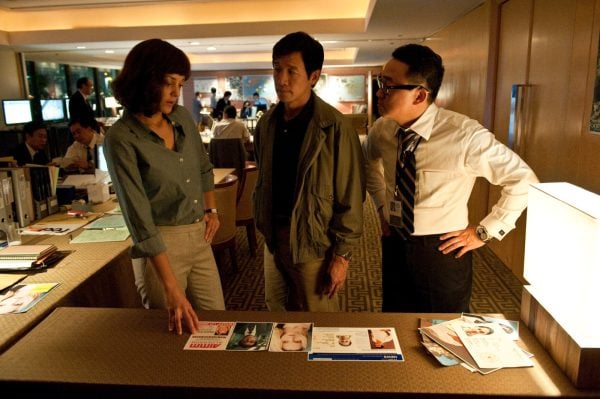
Apart from his directorial duties Steven Soderbergh also functioned as the film’s Director of Photography. The filmmaker used Red Digital Camera’s RED One MX digital camera which had the ability to give the sharp, high-resolution image output he desired. Contagion was a global production with shooting taking place in Hong Kong, Abu Dhabi, London and San Francisco. Multiple location in the state of Illinois, including Chicago and its suburbs such as Skokie, Glencoe, Elgin and Western Springs stood in for Minneapolis, Atlanta, and the Centers for Disease Control and Prevention (CDC). Other movies directed by Soderbergh that were also lensed by him include Traffic, Che, the Oceans trilogy and the Magic Mike series.
The prop of Gwyneth Paltrow’s head being used in Contagion became a popular internet urban legend
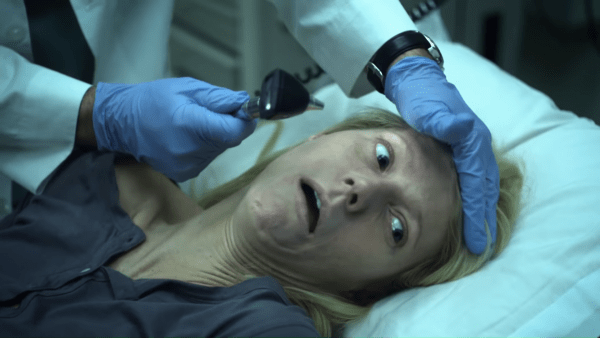
During the time of Contagion’s debut, an absolutely wild and popular urban legend did its rounds in the internet claiming that the prop of Gwyneth Paltrow’s head used in Se7en (for a deleted scene of that infamous scene) was put into storage and later reused for Contagion. However, Se7en director David Fincher debunked that myth by clarifying that a prop of Gwyneth Paltrow’s head was not even made during production, as they chose not to show the contents of the box to begin with. Paltrow achieved the autopsy scene in Contagion by simply lying absolutely still on a table for a period of 40 minutes with her appearance altered by the makeup department beforehand.
Matt Damon viewed his character as the embodiment of the “everyman”
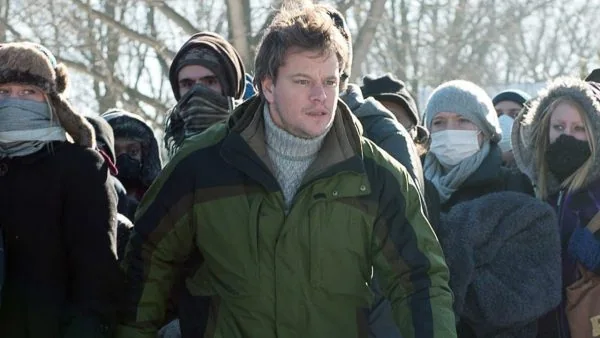
Getting his breakthrough performance with Good Will Hunting, which he co-wrote with his best friend Ben Affleck, Matt Damon further established himself as a leading man with efforts such as The Talented Mr. Ripley, the Bourne franchise and the Ocean’s trilogy. In Contagion, Damon plays Mitch Emhoff, who more or less acts as the audience surrogate through who we see the chaos unfolding with the advent of the fictional pandemic. In addition, Damon plays the emotional anchor of the ensemble thriller, eschewing overt melodrama in favor of a grounded and understated performance that was both poignant and very human. During a behind-the-scenes interview Damon recalled his reaction after receiving a copy of the script by Burns which had a “read this and then go wash your hands” note attached, “I just really want to be in this movie. It was a terrific, riveting, really fast read and really exciting and really horrifying, but managed to be really touching.”
Jude Law played an unscrupulous conspiracy theorist in the film
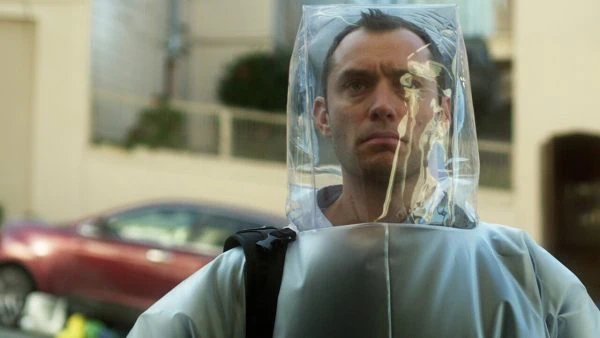
Jude Law first gained international acclaim for his role as the dashing Dicky Greenleaf in Anthony Minghella’s adaptation of the Patricia Highsmith psychological thriller The Talented Mr. Ripley, where he starred opposite his future Contagion co-star Matt Damon. His brilliant performance received rave reviews garnering a BAFTA for Best Actor in a Supporting Role as well as an Oscar nomination. He received further praise for his work on A.I. Artificial Intelligence, Road to Perdition and Cold Mountain as well. In Contagion, Law played an unhinged, conspiracy theory peddling blogger named Alan Krumweide, who falsely claimed that he was cured of the deadly virus using a plant-based remedy called Forsythia. The character was created by Burns during the 2009 Pandemic Flu lockdown period, where he observed how “everything was happening online” and that people would also get their information from online sources to be ahead of everyone else.
The film received an upsurge in popularity during the Covid-19 pandemic

Although release in 2011, Contagion received a significant upsurge in popularity and publicity at the start of the Covid-19 pandemic, where many recalled the startling parallels this film had with what was unfolding, around the world, in real-life. The movie’s fictional MEV-1 virus is composed of bat and pig viral strains whilst the origins of the Covid-19 pandemic was traced back to bats originating from Wuhan, China according to sources. The popularity of the property was so great that it literally raced to the top of the iTunes rental chart and the catalogue titles of Warner Bros. as well. During an interview conducted in May 2021 with the LA Times, Soderbergh elaborated that he felt that making Contagion certainly prepared him well for some of the realities of living through a global pandemic and other unexpected trends that emerged as well which was touched on during the interview, “Scott and I were trying to keep the narrative very focused and we had rules about points of view and what we can see and what we couldn’t see. But wow, there’s a lot of really fascinating human behavior that we didn’t even think about when we were doing this…. It’s just a reminder of how deeply irrational we are. When we’re put into some sort of fear-threat space, we become deeply illogical. It’s crazy to witness.”
Modest box-office wins, critical acclaim and an unexpected legacy
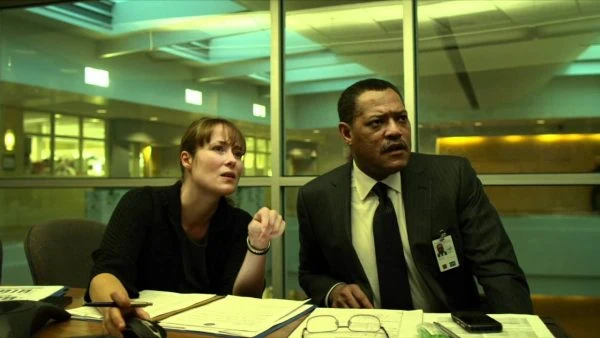
Made on a budget of $60 million Contagion went on to make a decent return of investment raking in a modest $136.5 million at the worldwide box-office. Most of the big name A-listers featured in the film famously took massive pay cuts to star in Steven Soderbergh’s ensemble piece, which considerably reduced the overall production budget of the movie. Contagion received positive reviews from film critics, at the time of its debut and as of writing boasts a respectable 85% on review aggregator site Rotten Tomatoes. The website’s critic consensus summarizes the movie in the following manner, “Tense, tightly plotted, and bolstered by a stellar cast, Contagion is an exceptionally smart – and scary – disaster movie.” The effort received praise from scientific circles who approved of Contagion for accurately capturing the diseases transmission process and the arduous risk mitigation efforts that health authorities must adopt when an outbreak takes place.
The film’s resurgence in popularity a few years later was certainly an unexpected one, and took place due to the Covid-19 global pandemic. Apart from rising up the ranks in iTunes rentals and the Warner Bros. catalogue the flick was one of the most downloaded in piracy sites the world over. As the movie continued its popularity streak the ensemble cast even reunited to give a public service announcement with the collaboration of Columbia University Mailman School of Public Health in March 2020. Regardless of what your thoughts are regarding the origin and subsequent management of the Covid-19 pandemic, there’s no doubt that Contagion truly captured the chaotic uncertainty and the crippling fear a pandemic unleashes in near-prophetic fashion. This makes Contagion an absolute must-watch if you are into suspenseful stories about deadly outbreaks that threaten society.
What are your thoughts on Contagion? Let us know on our socials @FlickeringMyth…
Hasitha Fernando is a part-time medical practitioner and full-time cinephile. Follow him on Twitter via @DoctorCinephile for regular updates on the world of entertainment.