
Cinematic lyrical poet Victor Kossakovsky (Architecton, Gunda) offers in Holy Wood Dust another distinctive non-fiction meditation on a theme, a work that’s eloquent even if the author’s message is not always explicitly articulated. This time the subject is trees, mostly living ones growing, or at least trying to grow, around the Dolomites in Northern Italy — though the focus broadens to incorporate trees grown on an industrial scale for the Christmas season, especially in Germany.
While the cinematography, credited to DP Gianmarco Donaggio, roughly meets the same visually sumptuous standards one expects from Kossakovsky and his crews — the drone shots’ soaring spectacles are especially compelling — Holy Wood Dust feels a bit lacking in purpose and thrust. Perhaps it falls back a little too often on mini forest-school lectures from amiable botanist Stefano Mancuso, a key collaborator here, reeling off interesting tree facts to a gaggle of Italian school kids.
Holy Wood Dust
The Bottom Line
Wood you like to see some trees?
Venue: Venice Film Festival (Venice Open — Out of Competition)
With: Stefano Mancuso
Director: Victor Kossakovsky
Screenwriters: Stefano Mancuso, Victor Kossakovsky, based on an idea by Stefano Mancuso
1 hour 45 minutes
Things have recently gotten a little spicier and more innovative in the nature documentary space, making this feel a bit old-school compared to, say Jesse McLean’s wonderful Light Needs, an experimental work about indoor plants that literally gives our potted pals voices, or the recent kaleidoscopic crowd-sourced feature Super Nature by Ed Sayers. French doc Heart of an Oak from a few years back, on the other hand, is comparatively less formally innovative, but by focusing on just the one tree and getting stuck right in to how that forms a micro-ecosystem on its own, it feels more cohesive and rich in factoids than the wafty approach allows here.
Smoothly edited by Kossakovsky-regular Ainara Vera, Holy Wood Dust gains a stronger semblance of coherence by the generous use of classical music alongside Adrian Berenguer’s bespoke original soundtrack. In other words, there’s a lot of string instruments in the mix, which is apt given that the red spruce trees that get a starring role here are the species much favored by Stradivarius making violins on account of their natural resonance.
Indeed, Mancuso argues sincerely that plants are the most precious materials in the universe because they are so rare, while out among the stars there are planets made of gold and other highly valued metals. He also explains to his young charges, and therefore the viewers, that trees are beings that think without a brain, communicating with one another at great distances.
Others’ mileage will certainly vary, but personally I would have liked more of the hardcore botanical science and less of the footage observing loggers in action, cutting down trees either as normal forest maintenance or to be sold as Christmas trees. Shots of evergreens getting fed into netting machines to make them more transportable are mesmerizing in an ASMR-video way for a little while, but they arguably go on longer than strictly necessary.
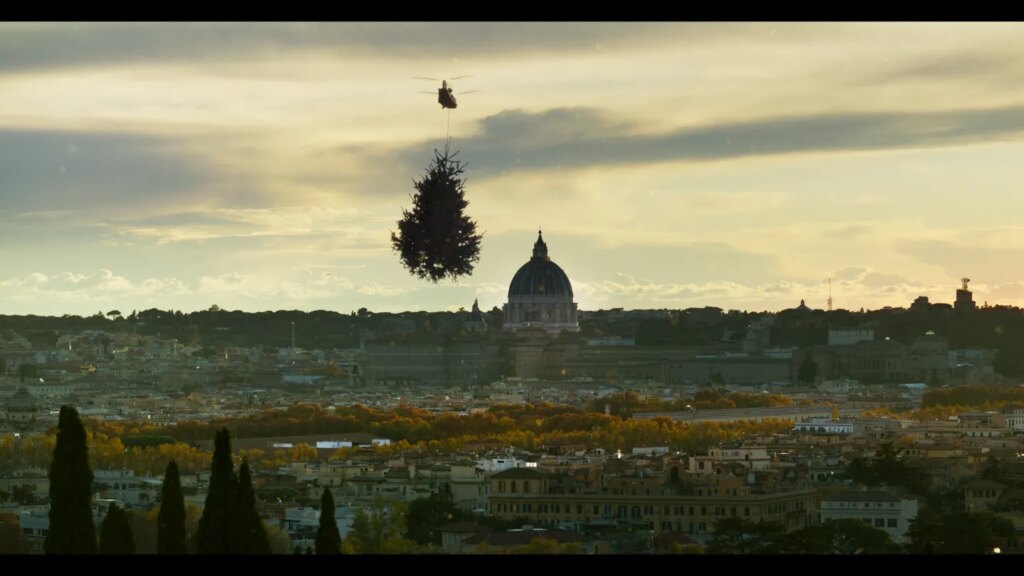
That also applies to a sequence where we follow an enormous lopped-off crown of one spruce as it travels to the Vatican in order to be the big Crimbo tree in St. Peter’s Square. Presumably this partly explains the pun of the title, although it doesn’t entirely land. Perhaps backers Rai Cinema were especially keen on that bit because one can easily imagine this ending up on Rai channels as seasonal entertainment and others like that around the world when ’tis the season to be jolly and mindful of all things arborescent.