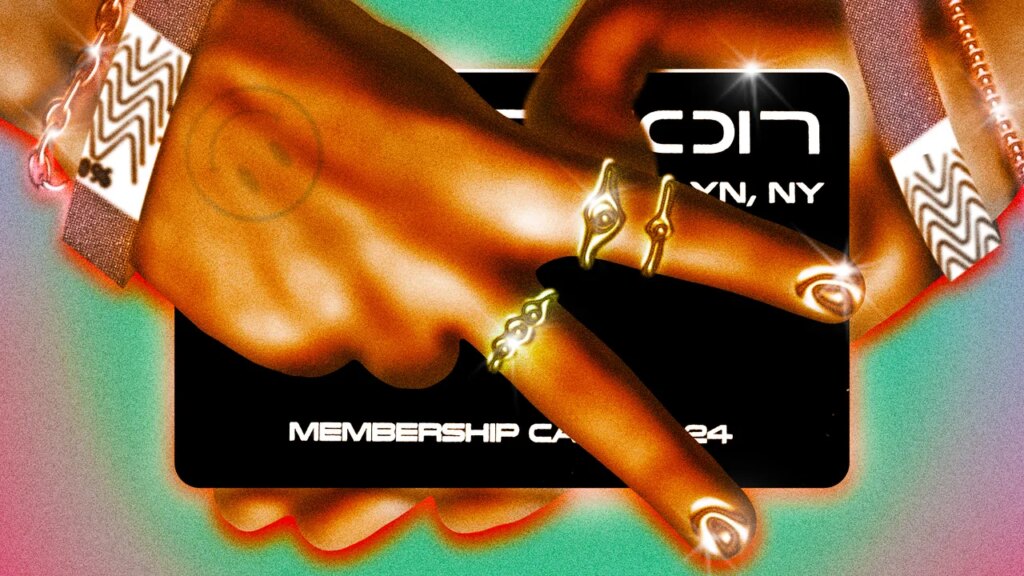

Dylan doesn’t think he was a more suitable candidate than any other club rat. He goes out dancing frequently, sure, but doesn’t hit any one venue often enough to be considered a loyalist, at least not by his estimate. And yet, last August, an email showed up in his inbox. “You are invited,” it read, prompting him to click the embedded link to begin his application. Dylan was asked to provide a “portrait-style photo” and the usernames attached to his Instagram and RA Guide accounts. He decided to make his Instagram account public, so his anonymous adjudicators could see that, in addition to being a recommended party guest, he was also “young and beautiful and Asian.” Within five hours of submitting the necessary materials, Dylan’s application was approved. He recalls being “really gagged” by the swiftness of the decision. But he didn’t contest it. He was now a card-carrying member of Basement, a nightclub in Queens known, colloquially, as the “Berghain of New York.”
You may recognize Basement’s throbbing, dungeon-esque interior from the Nicole Kidman dom-com Babygirl. Not unlike the actual Berghain in Berlin, Basement is notorious for its winding queues, all-night tech-head DJ lineups, and strict no-camera policy. (Recently, the cavernous Flushing Ave haunt updated its zero-tolerance filming rules: Anyone caught bringing smart glasses into the venue risks a lifetime ban.) The door is not quite as rigid as Berghain’s, but tickets to hot parties sell out quickly, and even ticket-holders often wait in line for hours. But being a friend of the venue guarantees ticket availability and the privilege of entering through the members line, which is comically shorter than the regular one.
“It’s a very arbitrary process. I don’t think that I’m cooler than any of the people that I referred who didn’t get approved,” Dylan muses. He was referred to the program by a friend he sometimes sees on the dancefloor and at the gym—someone he describes as “just a regular raver, not a famous DJ” or even “very active in the scene.” In addition to a member referral—card-holders are permitted three referrals, replenished only if the person referred gets approved—Basement’s guidelines state that a member may be asked to write a short letter of recommendation for applicants who do not provide enough information. Some partiers with a more dedicated Basement attendance record told me they waited weeks only to be declined. But Dylan says he was accepted rather quickly. Now, on a given night at Basement, all he has to do is access Basement’s member portal on his phone’s browser and show the bouncer a QR code. (Even this elite status has its limits: “If you’re going with a group of people—which happens quite often—if they have a ticket, but they’re not a member, you have to wait with them,” Dylan says. “Or you could say, ‘Fuck you. I’ll see you inside,’ but that I kind of don’t feel good about because that’s kind of a dick move, honestly.”)
The secret-ish, if-you-know-you-know club membership has its precedent in dance havens of yore. In 1978, the New York Times reported that 18,000 people had applied for a Studio 54 membership card, with only 3000 making the cut. Patrons paid $75-$100 in exchange for a card emblazoned with the venue’s iconic Art Deco logo, which guaranteed admission and a $3 discount on cover charges. But as Studio 54 exploded in popularity, access grew extra-exclusive. Once the club stopped automatically admitting card-carriers, the New York City Department of Consumer Affairs shut down the program. Still, Mudd Club, which opened shortly before the epic demise of Studio 54, offered laminated ID cards to those enrolled in “Mudd College of Deviant Behavior,” allowing them to bypass the venue’s capricious door policy. (Notable Mudd alums include Keith Haring, Anna Sui, and Kim Hastreiter.)
John Barclay, owner of Brooklyn’s Paragon and Bossa Nova Civic Club, started a membership program for the latter venue around 2014. It was conceived as a token of gratitude for those who frequented the space regularly, not just on “hot nights”; Barclay secretly hoped it would reduce the number of late-night calls he gets from acquaintances with list requests. “I’ll be in bed—this happens to me all the time—it’s like 2 a.m. and I’m asleep and people call my phone five times to try to save 10 bucks at the door,” Barclay groans. “And it’s always some guy my age.”