
People sometimes think product placement in media began with Reese’s Pieces in Steven Spielberg’s E.T. the Extra-Terrestrial, but the concept really dates back much further.
Indeed, the first movie to ever win the Best Picture Oscar, William’s A. Wellman’s Wings, prominently featured Hershey’s chocolate bars (more than half a century later, the candy company hit a rich vein of cinematic gold with Spielberg’s sci-fi classic after M&M’s passed up what we now know to be the marketing opportunity of a lifetime).
Synergy between consumer products and entertainment also extended to early television, with the Ford Motor Company providing nearly all of the cars used on season one of The Twilight Zone at no cost, according to Martin Grams Jr. in The Twilight Zone: Unlocking the Door to a Television Classic. The show even managed to get its hands on a Ford Model A, as seen in another season one installment, “The Lonely.”
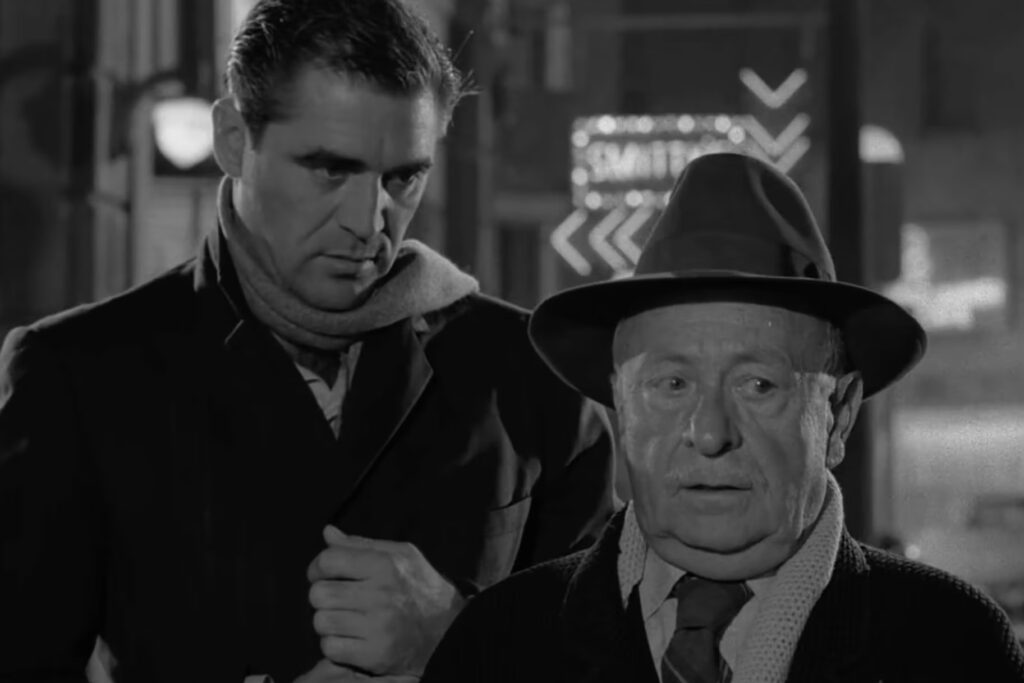
However, the creatives behind the fifth dimension had to use a different brand of car while filming season one episode “What You Need,” which ends with antagonist Fred Renard (Steve Cochran) getting run over and killed after he’s given slippery shoes by psychic street peddler Pedott (Ernest Truex).
“Since automobile manufacturers promote the safety features on their products, and Ford gave [Twilight Zone creator Rod Serling’s production company] Cayuga free use of their vehicles,” wrote Grams Jr., “it seemed appropriate to have an automobile other than a Ford be used for that scene.”
The book, however, does not reveal what make they went with in the end.
Lewis Padgett’s short story of the same name, which Serling adapted into the script, had already been translated to screen for ABC’s pre-Twilight Zone anthology, Tales of Tomorrow, seven years prior in 1952.
Interestingly, the live broadcast (watch below) starred Edgar Stehli, who would go on to appear opposite Kevin McCarthy’s immortal college professor in yet another episode of Twilight Zone‘s debut episode, “Long Live Walter Jameson.”
Serling’s take on Padgett’s source material set itself apart from the Tales of Tomorrow rendition by swapping a machine capable of seeing into the future for a human being with the same uncanny talent. As noted by Grams Jr., the concept of a precognitive device was explored the following season in “Nick of Time.”
Classic episodes of The Twilight Zone air regularly on SYFY. Click here for complete scheduling info!