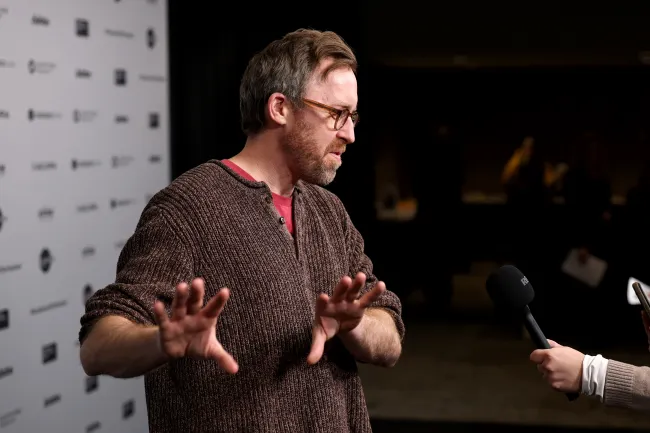

John Wilson has done a lot of things while making his latest documentary and first feature film, “The History of Concrete.” He’s found himself at brick-laying conventions and Long Island metal shows, the most ordinary (and fascinating) corners of all five boroughs, and at a fancy GQ dinner where he was in the rare position to film some uninterrupted, unmediated footage of Kim Kardashian.
But unlike the seemingly different ideas that Wilson is able to find absurd and poignant connections between in his documentaries, his other project while making the film is one that almost makes too much sense. It’s now been about a year since Wilson and his partners, Davis Fowlkes and Cosmo Bjorkenheim, opened the Low Cinema in Ridgewood, Queens.


The Low is a 42-seat, one-picture movie house, which at the moment has sold out its showing of “The History of Concrete” but generally plays, in the words of its charmingly lo-fi website, romantic comedies, sports movies, legal thrillers, Technicolor musicals, action, observational documentaries, and more for all your cinema needs.
Starting a microcinema is simply a part of how Wilson thinks about films, though, and about the important role that art has in binding a community together — not so unlike a certain composite of aggregate and fluid cement that we all know and love. “It felt almost involuntary,” Wilson told IndieWire on a recent episode of the Filmmaker Toolkit Podcast. “They started working on the cinema around the same time I started working on ‘Concrete’ — maybe because I needed to have a movie theater play my movie if nobody else wanted to distribute it.”

But introducing movies into your community is another way in which to perform that magic trick that Wilson’s movies themselves pull off, which is to make us see things that see the familiar world around us in completely new and wondrous ways.
“I do older adult center screenings every month. My girlfriend helps to organize them because she’s very organized and she volunteers there. And they get to choose the movie. It’s usually something very horny,” Wilson said. “Last week they watched ‘The Notebook’ and a lot of them had never seen ‘The Notebook’ before. There was one old timer who was like, ‘I’ve seen “West Side Story” a million times. This movie, never.’ I was like, ‘Thanks.’ You [came here] a one movie man; now you’re a two movie man.”
Helping viewers get halfway to a new Letterboxd top four aside, the Low has been a way for Wilson to embed into his community in a way that lasts beyond a single documentary project — and the ennui that came come from not having a documentary project, as “The History of Concrete” itself gets into. “You could tell people just needed it,” Wilson said. “And I just love the idea that we can repopulate our cities with these kinds of cultural nodes that could be cinemas, but whatever. We need to bring back movie theaters that are the size of porno theaters that don’t necessarily show porn.”
The important thing for a microcinema is that it feels permeable and that a community can feel like they have a stake in it. Wilson is delighted with the fact that the Low has regulars and that the project, so far, has been self-sustaining. Because of the deliberately micro size, too, the team managing the Low can be nimble and respond both to community requests and wide releases in funny ways that Alamo and AMC can’t.
“James Cameron fucked everything up by making us all convert to digital to screen ‘Avatar’ in 2009 or whatever, and I’m not saying that was what decimated all indie theaters, but it was this final swell of the mega theater, as it continued to grow into this unsustainable place,” Wilson said. The renaissance of small cinemas in New York includes the Low, but also theaters like Negative Space in Bushwick, the Spectacle Theater in Williamsburg, and Film Noir Cinema in Greenpoint.
“That’s why you live in cities,” Wilson said.
“The History of Concrete” is now playing in theaters.