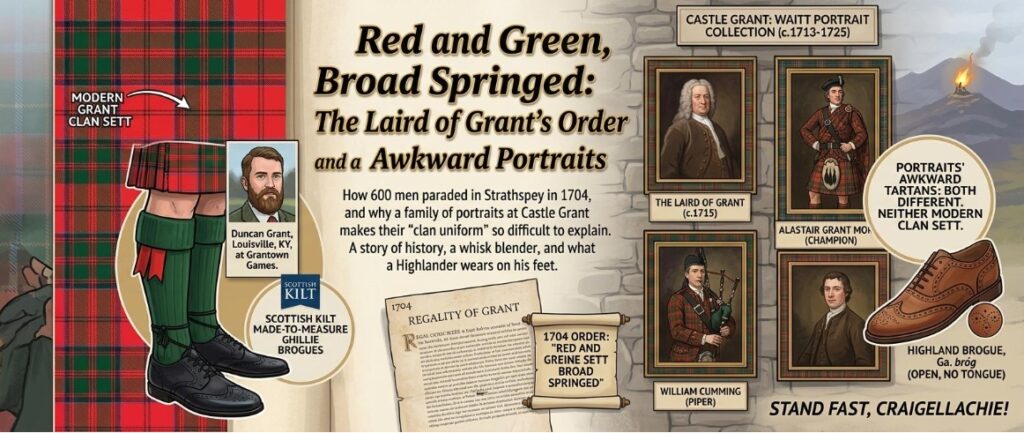

In the summer of 1704 the court of the Regality of Grant, sitting in Strathspey, issued an order to every able-bodied tenant on the estate. They were to hold themselves ready to attend their laird, on forty-eight hours’ notice, for a great hosting and hunting. And they were to come properly dressed. Each man was to have “Heighland coates, trewes and short hoes of tartane of red and greine sett broad springed,” along with a sword, a pistol and a dirk.
Red and green sett, broad striped. It is one of the most quoted sentences in the whole history of tartan, because it appears to be exactly what enthusiasts had always hoped to find: proof, in a dated legal record, that a Highland clan wore a uniform tartan long before the nineteenth century got its hands on the subject. The Grant name would eventually become associated with the distinctive Grant tartan, a red-and-green sett whose history is tied to this much older evidence, even if the modern clan pattern was not fixed until much later.
Six years later, in 1710, the old laird handed over the leadership of the clan to his son at a ceremony on the moor of Ballintomb. Six hundred men of the name turned out. They were all, a witness recorded, in red and green.
So far, so satisfying. And then you go and look at the pictures.
The painter at Castle Grant
The Grants were one of the great powers of the central Highlands. Their country was Strathspey, the broad middle valley of the River Spey between the Cairngorms and the hills of Cromdale, and their seat was Castle Grant, outside the town that now bears their name, Grantown. Their gathering place was the rock of Craigellachie, above Aviemore, where a beacon was lit to call out the clan, and their war cry is one of the best known in Scotland: Stand fast, Craigellachie! The chief’s crest is a mountain in flames.
The laird of 1704 was Ludovick Grant, a man of such local consequence that King James VII is said to have called him, not entirely as a compliment, His Highland Majesty. His son Alexander, who succeeded him at Ballintomb, had a taste for display, and about 1713 he brought to Castle Grant a portrait painter named Richard Waitt. Over the next dozen years Waitt painted the whole establishment. There were dozens of canvases: the laird, his relations, his leading gentlemen, and, most unusually for the period, two of his household retainers at full length.
Those two are among the most famous Highland portraits ever painted. One is William Cumming, the laird’s piper, in full cry, with Castle Grant behind him. The other is Alastair Grant Mor, the laird’s champion, a huge man with a broadsword, a targe and a ferocious stare. Both are in tartan from neck to knee, painted by an artist who plainly took trouble to get the pattern right.
Here is the difficulty. The piper’s tartan and the champion’s tartan are different. Neither of them is a simple red and green. Neither resembles the Grant tartan worn today. And when scholars went through the rest of Waitt’s Grant portraits, they found at least half a dozen different setts on the various members of one family, painted in one house within a few years of one another.
What it means
Historians have been arguing about this for a century, and the sensible conclusion is a modest one.
The order of 1704 was real. But “red and green, broad springed” is a colour scheme, not a thread count. The laird wanted his men to look like a body when they paraded, as any commander would. He did not hand each of them a pattern, because there was no pattern to hand. Every household wove or bought its own cloth, to its own taste, within the general instruction. In ordinary life, as the portraits show, a Grant wore whatever tartan he liked.
In other words, the Grants of 1704 stood exactly halfway between the old world, in which tartan was simply cloth, and the new one, in which it would become a badge. It took another hundred years, the tartan ban, the Highland regiments and the great Bannockburn weavers to finish the job.
When it was finished, the Grants got a red and green tartan after all. The clan sett worn today can be traced to the 1819 Key Pattern Book of William Wilson & Sons, where, the tartan archives note, it evolved from a pattern the firm called New Bruce. Clan Drummond wears the same design. It is a bold red ground with broad bands of green, the two crossed by narrower lines of black, a little red, and one fine stripe of light blue. Old Ludovick would have approved of the colours, at least.
There is a second Grant tartan with an older pedigree. One of General Wade’s six Independent Companies of 1725, the original Black Watch, was commanded by a Grant, and much of its dark plaid was woven by the weavers of Strathspey. The clan has worn the Black Watch sett as its hunting tartan ever since.
Retailers who stock Grant tartan usually carry the red clan sett in Modern, Ancient and Weathered colours alongside the hunting, made to order as kilts, skirts, waistcoats and scarves, or sold by the yard.
Look at their feet
There is one thing Waitt’s portraits do not show, and that is what the six hundred men on the moor had on their feet. The piper and the champion were dressed in their best for the painter, and wear the buckled shoes of any gentleman of the day. The ordinary clansman wore something much older.
It was a low, light, flat affair of soft leather, open over the instep and held on by a thong. This is the Highland brogue, from the Gaelic bróg, a shoe. It was made at home from a single piece of untanned deerskin or cowhide, hair side out, gathered round the foot with a lace.
It had one peculiarity that mattered more than any other. It was full of holes. A Highlander spent his life walking through bog, burn and wet heather, and no footwear then made would keep the water out. So he did not try. He punched rows of holes in the leather to let the water run out again as fast as it came in. The decorative perforations on a modern brogue shoe, the ones on a City banker’s Oxfords, are the fossil of that drainage system.
The shoe worn with Highland dress today descends directly from it. It is called the ghillie brogue, after the gille, the lad or attendant who carried a gentleman’s gear on the hill. It has two odd features, and both are practical. It has no tongue, so that a soaked shoe would dry more quickly. And it has very long laces, which were tied up round the ankle, above the mud, where they would not be dragged loose.
Grantown-on-Spey, the second week of August
Duncan Grant is forty, a whisky blender from Louisville, Kentucky, and he has come to Speyside for two reasons. One is professional. The valley his clan comes from happens to contain about half the malt distilleries in Scotland. The other is the Highland games at Grantown, where he intends, for the first time in his life, to wear the kilt in his own country.
He has the kilt, in the red Grant, made to measure. He has the jacket, the sporran and the hose. What he forgot, until a week before the flight, was his feet, and he has been typing kilt boots into search engines without quite knowing what he is looking for. What he is looking for, it turns out, is not a boot at all. It is the ghillie brogue.
He found his at Scottish Kilt, the outfitter that had made the kilt. Theirs are genuine leather, in black and brown, with no tongue and long laces that wrap the ankle, and the description adds, with a nice sense of history, “so wet ground drains out.” They are ordered in your usual shoe size. He took black, since he has one pair and they will have to serve for evening as well as day. Brown, he was told, is the country choice, handsome with tweed, but black will go anywhere.
The laces defeated him until the man in the bed and breakfast took pity. You do not wind them up the calf like a Roman sandal, which is the mark of a beginner. You pull them snug, cross them, and twist them round each other three or four times at the front of the ankle to make a little column. Then you take the ends round the back of the ankle, bring them to the front, and tie an ordinary bow, slightly to the outside, just above the ankle bone. The tassels hang down. The whole arrangement should sit low and tight. Done properly it will stay tied through a day on a games field and a night of dancing.
With hose in bottle green, picking up the green of the tartan, and red flashes, his legs look, for the first time, as if they belong to the rest of him.
On the Saturday he walks onto the field at Grantown among a few thousand people, a good many of them called Grant. The ground is soft after rain. Within ten minutes his shoes are wet through, and he discovers that it does not matter in the least.
In the afternoon he drives the three miles out to look at Castle Grant from the road, grey and shuttered among its trees. Somewhere in there, he thinks, a piper and a champion stood for their portraits three hundred years ago, in tartans nobody can now put a name to.
Stand fast
The Grants have the best early evidence for a clan tartan in all of Scotland, and the best evidence against it, hanging in the same family’s collection. The honest reading is that both are true. They were a proud, organised, showy clan who liked to parade in their colours, and they were also ordinary Highlanders who wore whatever cloth came off the loom.
The tartan was fixed by a weaver in 1819. The shoes are older than any of it. When a Grant laces his ghillie brogues low round the ankle and walks out across wet grass in red and green, the part of his outfit that Ludovick’s six hundred men on the moor of Ballintomb would recognise soonest is probably on his feet.